The China Dish journal / A closer look
Yixing Teapots and Literati Culture: Chen Mansheng’s Circle
Yixing teapots and literati culture meet in objects shaped by both potters and scholars. In Chen Mansheng’s circle, making a vessel, designing it and contributing its writing could involve different people. The name Mansheng therefore leads into a collaboration: a low teapot dated 1815 connects the potter Yang Pengnian with Chen and another writer, Guo […]
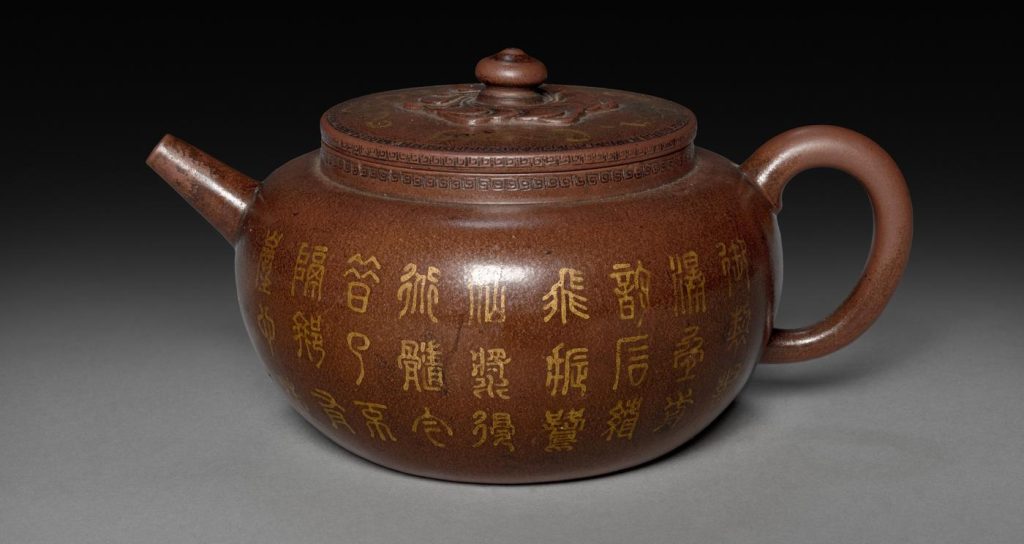
Yixing teapots and literati culture meet in objects shaped by both potters and scholars. In Chen Mansheng’s circle, making a vessel, designing it and contributing its writing could involve different people. The name Mansheng therefore leads into a collaboration: a low teapot dated 1815 connects the potter Yang Pengnian with Chen and another writer, Guo Lin.
Two surviving pots help make those relationships concrete. Their shapes and inscriptions offer a way into the social life of the objects, even when we can’t reconstruct every conversation around them.
Chen Mansheng brought the scholar’s arts to teapot design
Chen Mansheng was the name used by Chen Hongshou, a scholar-artist whose interests included calligraphy, painting and seal carving. Calligraphy gives shape and rhythm to written strokes; seal carving cuts characters into a small stamp. Both could enter a pot’s design alongside the work of forming clay.
The Hong Kong Museum of Art describes Chen commissioning teapots while serving as magistrate of Liyang, a county near Yixing. Its account connects him with designs traditionally described as eighteen styles. The Palace Museum, in Beijing, also records Chen commissioning teapots from Yang Pengnian during the Jiaqing reign.
Design gave the writing a place on the clay: to see a pot’s shoulder and belly as surfaces for a text is to consider the form and the words together. Chen’s name can’t tell the whole story.
Within the Yixing guide, this essay follows the people around the pots; nearby topics take up clay color and objects for a scholar’s desk.
An 1815 teapot brings Guo Lin into Mansheng’s circle
One pot makes the collaboration wider than the familiar pair of Chen and Yang. The Hong Kong Museum of Art dates its low cylindrical teapot, collection number C81.496, to 1815. The record identifies Yang Pengnian’s seal, Chen’s studio name Amantuo Shi, and an inscription by Guo Lin, also known as Pinjia.
The pot has a broad shoulder, a low body and a short spout. Look at the writing on the shoulder, then the band on the wall: the shallow profile makes the two surfaces easy to see.
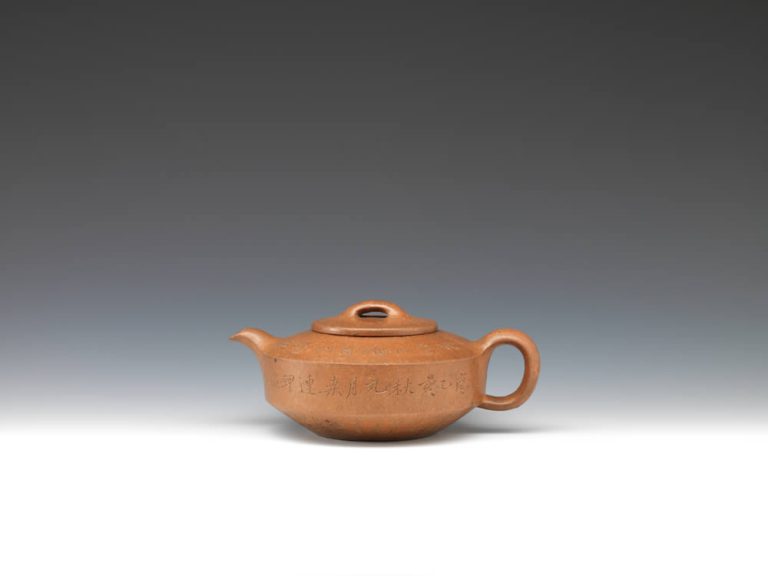
The catalogue also records a number in the inscription: 1,379. I read it as a detail of this pot, not a tally for Yang’s career: a number on clay doesn’t tell us how many pots he made in all.
Fifteen names suggest a gathering around the teapot
Guo Lin’s text adds another hand, but the pot’s social ties reach further. The museum’s older account describes fifteen names on its lower belly, presumed to belong to Chen’s friends who examined the vessel at a literary gathering. Its newer catalogue places the names underneath and describes friends and house guests participating in its appraisal.
The names don’t tell us what the guests said. I can’t recover their talk from the list, and the older account’s caution seems fair: it offers a reading of the marks rather than a scene we witnessed.
A group of readers now has a place beside the potter and the writer. Their names suggest people who looked at the result together, drawing the pot into a shared life beyond the bench.
A gourd-shaped teapot in Mansheng’s circle
Makers still mattered within that wider circle. The same museum’s official collection catalogue lists a gourd-shaped teapot, C81.401, from the early nineteenth century. It lists seals of Yang Pengnian and Jihu, with an inscription by Mansheng.
The body swells below a narrower shoulder, and its lid rises toward a small, upright knob. Incised writing follows the front of the brown wall. The outline is quite different from the low cylindrical vessel, although both give writing room on the clay.
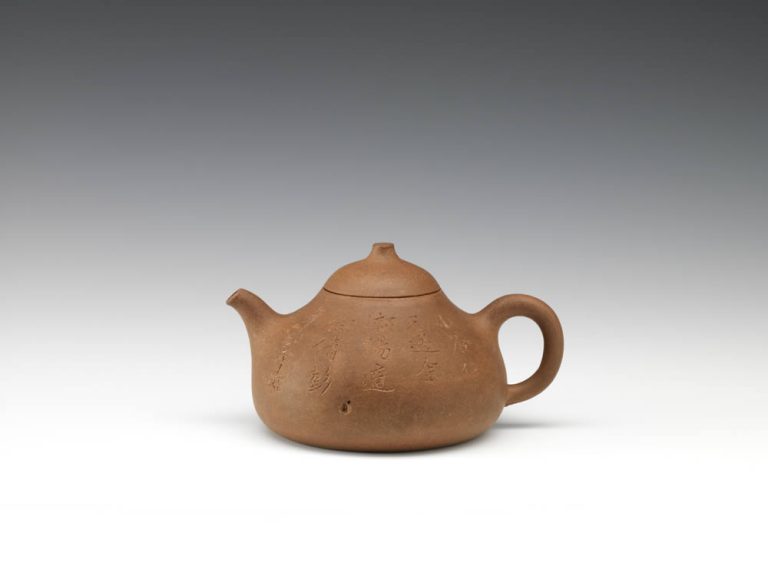
The credits deserve a close read. Yang’s name remains on the record. Mansheng teapot is a name for shared work, so I wouldn’t take it to mean Chen did every task with his own hands. Here the seal and written text have their own credits, held together by the shape of one pot.
Literati culture becomes visible through shared attention
Literati culture takes a concrete form in these pots. Scholars and artists brought their writing, taste and friends into the work of teapot makers.
Their involvement could reach from the conceived form to an inscription and the appraisal of a completed vessel. Chen’s circle gives us named people who worked together, rather than a broad claim about Chinese taste.
For a closer look at how text occupies a clay wall, the guide to teapot inscriptions follows the separate written surfaces of another vessel. The question here is who participated, and what the surviving record lets us say about each contribution.
Return to the low pot’s shoulder. Its writing now belongs to a chain of choices involving a maker, a scholar’s studio, a writer and a circle of readers. I don’t need to invent their talk to find that company worth noticing.