The China Dish journal / A closer look
Ceramic Decals: How a Printed Image Becomes Part of a Pot
See how a ceramic decal moves from paper to pottery and why a gold flower appears during firing. Compare overglaze decals with underglaze transfers.
A ceramic decal carries a prepared design from a sheet onto a pot. For a kiln-fired waterslide decal, water releases a thin film bearing the image from its paper backing. The decorator slides the film into place, smooths it against the glaze, and lets it dry. In the kiln, the film burns away and the ceramic color bonds to the surface. On one black porcelain mug, a decorator could see little more than a glossy patch before firing. Only afterward did a gold flower appear.
What slides off the backing paper?
Imagine moving a flower drawn in fine lines. If you had to move each petal separately, the drawing would soon lose its shape. The decal film carries the whole flower, including the spaces between the lines. The heavier paper underneath supports it until the moment of application.
Once wet, the film can move a little on the glaze. That gives the decorator time to turn a flower toward a handle or shift it clear of a rim. A pocket of air underneath can leave a hole in the fired image, which is why close contact matters even where the design already looks well placed. As the transfer dries, the adhesive holds it still. The lasting bond comes later, when the piece goes into the kiln.
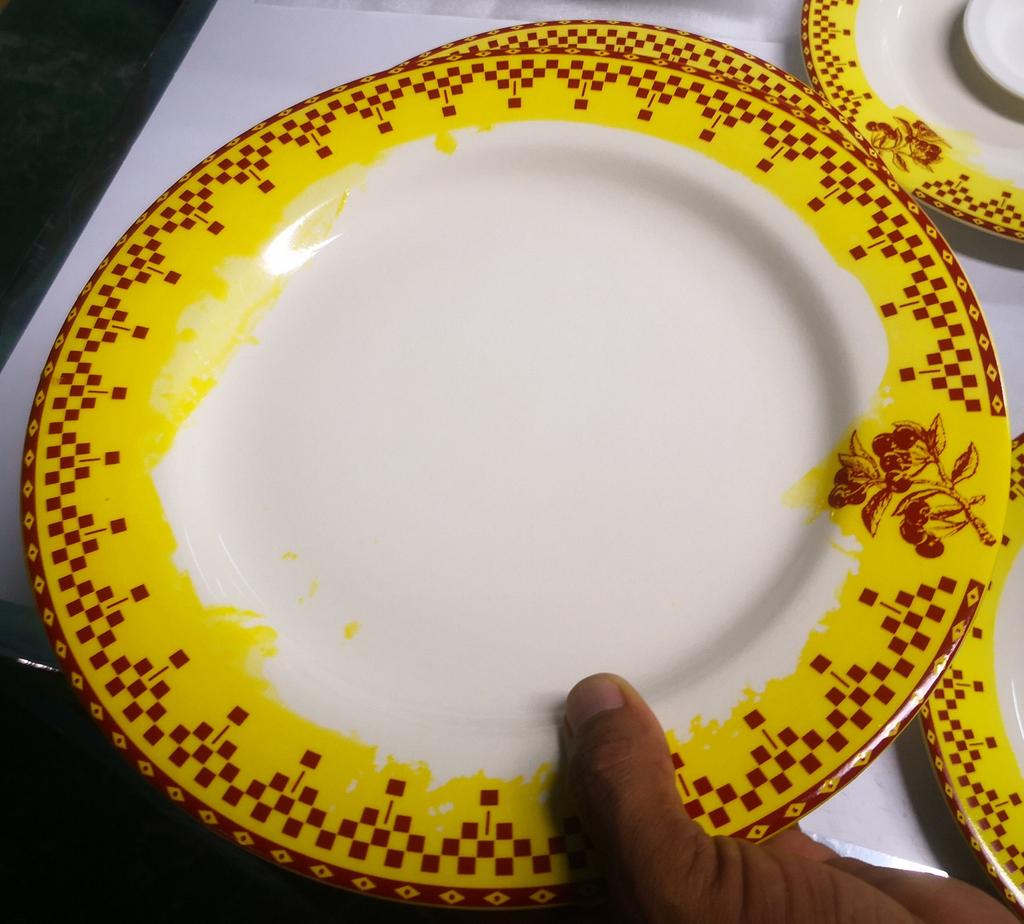
A reddish-brown checker border runs across the yellow area at the rim. This photograph shows the transfer during application. The fired color is unknown. Photograph by Encik Tekateki, licensed under CC BY-SA 4.0.

How Linda Gates put paper dolls on her jugs
The paper dolls Linda Gates remembered from childhood came with clothes that could be changed. Years later, when she found vintage dolls with torn or missing outfits, she could draw them new clothes. She combined drawings and scanned images and had her designs commercially printed as ceramic decals. By the time a sheet arrived at her studio, some of the handwork behind its printed figures had already happened on paper.
Gates chose a slip-cast jug with a smooth surface that made it easier to work air out from under a transfer. She gave the jugs underglaze borders and used an iron oxide wash to soften the bright white of the cast surface. Those marks went beneath a clear glaze. Once the clear glaze had been fired, Gates chose a group of cutouts for each jug.
In figure 12 of Gates’s chapter in Ceramic Mold Making Techniques, water loosens one image from its paper backing. On the jug, Gates could work bubbles out with a soft rib or sponge while the decal was still wet. By figure 13 the paper is gone, but a blue tint still surrounds the design. That blue belonged to the film carrying the ceramic inks. It burned away in the kiln.
Turn the page from the demonstration and there’s Make Do and Mend, a slip-cast earthenware piece Gates made in 2008. It stands just 5 inches (12.5 cm) tall. Its caption names digital transfers alongside slips, underglazes, and oxides. Read that list with Gates’s iron wash in mind. The worn look of the ground was a choice she made before a printed figure ever touched the glaze.
Does the design go over or under the glaze?
Look for the surface named in the instructions. A kiln-fired overglaze decal goes onto a piece whose glaze has already been fired. Gates’s paper dolls followed that route. An underglaze transfer can go onto clay that is still unfired or onto bisqueware, pottery that has had its first firing. A clear glaze can then cover the design. Both methods let a decorator carry an image to the pot on a sheet. They put that image at different depths in the finished surface.
The backing gives another clue. With Elan’s underglaze sheets, the decorator places the printed side of the rice paper against the clay, presses it with a damp sponge, and lifts a corner to see whether the color has transferred. On its kiln-fired overglaze decals, the image rides onto the glazed pot on a film. If you already have a glazed mug, that difference matters before you even choose a pattern. For the same distinction in brush decoration, see how color sits beneath or above a porcelain glaze.
What a before-and-after photograph can tell you
Digitalfire’s black mug is porcelain, with a satin-matte glaze and a gold decal from Sanbao Studio. In Digitalfire’s comparison, reflected light picks out the newly applied transfer on the left. On the right, the fired gold flower stands out against the dark glaze. Here the two photographs answer a precise question about one piece. They show how much the appearance of this particular decoration changed in the kiln.
The mug’s glaze had already been fired to cone 6 before the gold went on. If you find “cone 6 porcelain” in the description, that number belongs to the earlier firing. Digitalfire records a separate schedule for the decal. For a project of your own, use the instructions for the exact transfer and test it on a sample carrying the glaze you intend to use. You are looking at two things when it comes out: whether the image fired clearly and whether the surrounding glaze kept the surface you wanted.
Can you recognize a decal on a finished plate?
Compare the small details in repeated motifs. Do the tips of two leaves bend in precisely the same way? Is the same little gap present between two petals? Those observations give you something specific to ask a maker or look up in a catalogue. A repeated flower on its own gives you little basis for identifying the printing process, the age of the plate, or who drew the original design.
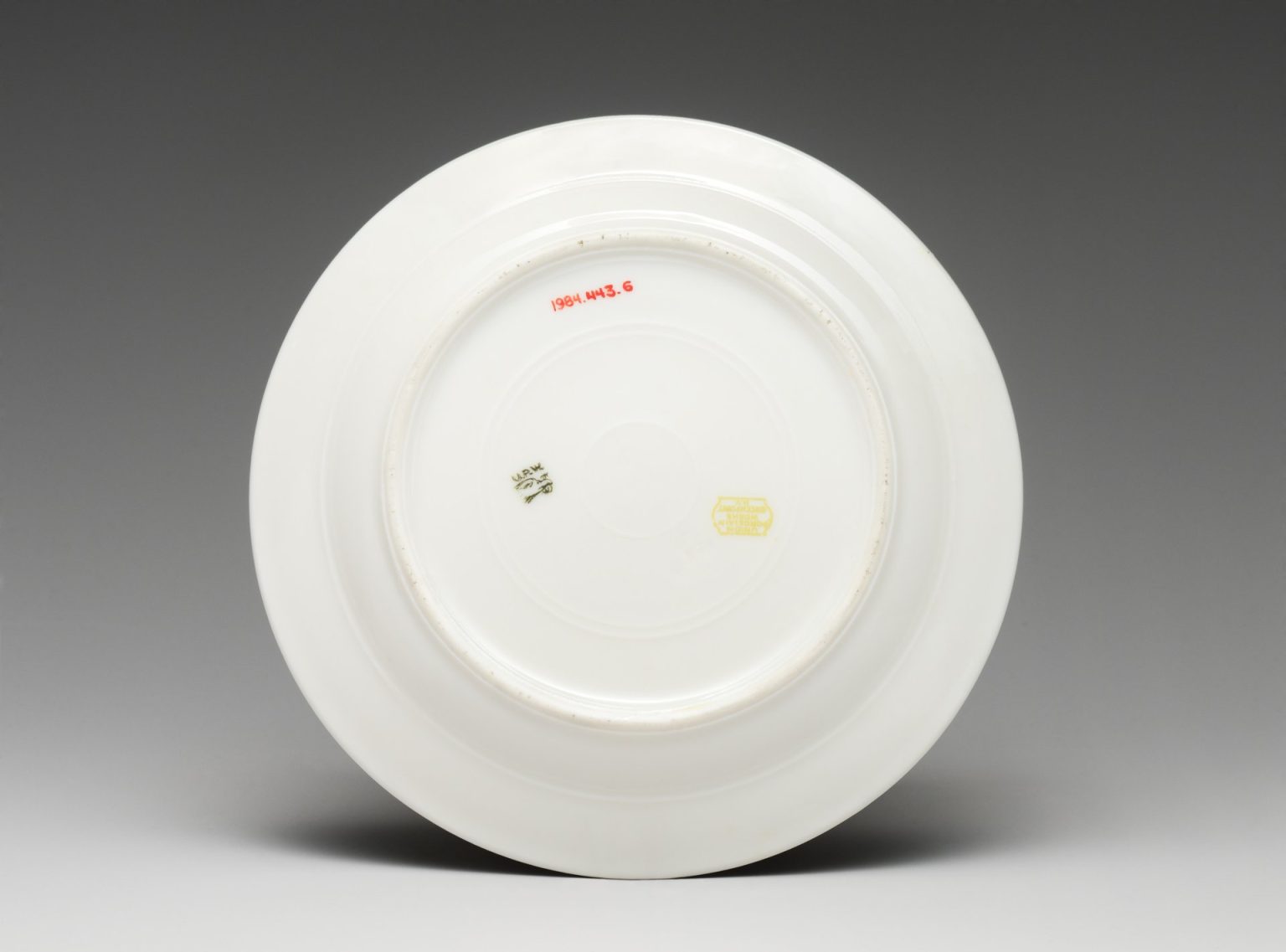
The red number inside the foot ring links this plate to the museum record that identifies the hibiscus decoration on its face. The Metropolitan Museum of Art, 1984.443.6, public domain.
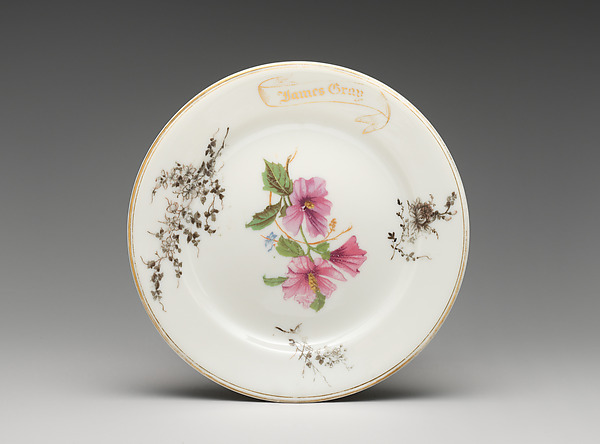
The Metropolitan Museum of Art records a porcelain plate made by Union Porcelain Works in Brooklyn in 1880–95. Its catalogue identifies the multicolored hibiscus as decalcomania, a transfer from specially prepared paper. On that plate the museum supplies the answer. On Gates’s jugs, the artist supplies something a finished surface alone could scarcely reveal: the printed figure may be wearing a dress she first drew by hand.