The China Dish journal / A closer look
Jiang Rong’s Zisha Water Dropper: Toad and Mole Cricket
A toad crouches behind a mole cricket on Jiang Rong’s zisha, or purple-clay, water dropper. The vessel takes the shape of a hollow tree trunk, turning a small tool for the writing desk into a scene of waiting and danger. Its animals, its use with ink, and the potter’s family training offer three ways into […]
A toad crouches behind a mole cricket on Jiang Rong’s zisha, or purple-clay, water dropper. The vessel takes the shape of a hollow tree trunk, turning a small tool for the writing desk into a scene of waiting and danger. Its animals, its use with ink, and the potter’s family training offer three ways into the same object.
The Flagstaff House Museum of Tea Ware in Hong Kong records this work as C81.451, made around 1980. It measures about 2.9 inches (7.3 cm) high and 3.7 inches (9.4 cm) wide: a small object that rewards a close look.
A toad watches the mole cricket on Jiang Rong’s trunk
The cut end of the trunk gives the water dropper a broad, patterned face. Rings run across its warm brown surface, while the side looks darker and rougher. The contrast gives me two clues to the log: a cut through the wood at one end, and irregular outer surfaces along its length.
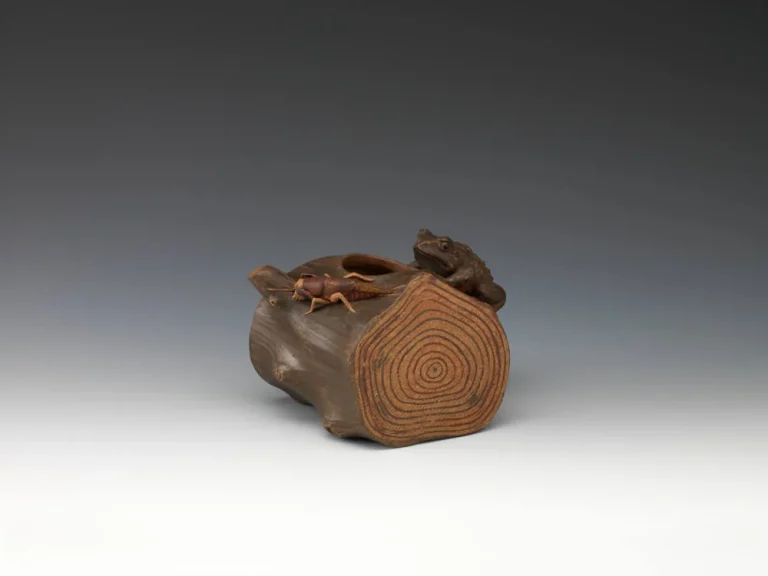
The insect stretches along the upper side near the short spout. Its narrow body and projecting legs contrast with the toad’s compact body and raised, uneven back. A dark opening separates parts of this little arrangement, giving the animals a setting with depth. The trunk holds the scene together without needing a separate landscape beneath it.
Hong Kong’s museum identifies the insect as a mole cricket and reads the pair as a predator approaching its prey. That reading gives their placement a purpose. The insect occupies one side near the outlet; the toad waits across the hollow trunk. What first looks like two small ornaments becomes a relationship between two creatures.
I’m drawn to the pause in that relationship. The toad’s raised head and the insect’s stretched legs suggest different kinds of movement, yet the clay holds both still. My eye moves between them before returning to the trunk. The pleasure is in having a little event to read, as well as individual shapes to admire.
Why Jiang Rong’s hollow trunk is a water dropper
The hollow trunk belongs on a writing desk because this vessel held water for preparing ink. A water dropper supplies small amounts to an inkstone, the surface on which an ink stick is ground for calligraphy or painting. Hong Kong’s museum identifies Jiang’s vessel as a scholar’s studio utensil.
That use changes how I look at the opening and spout. They belong to a container with a job to do, while the ringed end and animals make its outline interesting to follow. The practical parts sit within the trunk form. It’s possible to read the object as a little piece of nature and still recognize its place beside brush and ink.
The museum records Jiang’s surname and given name as seal marks on the base, a surface outside the view above. The Hong Kong Museum of Art collection entry provides the object’s recorded details.
Clay vessels for the writing desk are part of the wider world of Yixing objects. The site’s developing guide places them alongside teapots, poetry, and calligraphy. Here, the connection with writing comes through the water held inside the vessel and the scene modeled on its surface.
Jiang Rong’s family training and eye for living forms
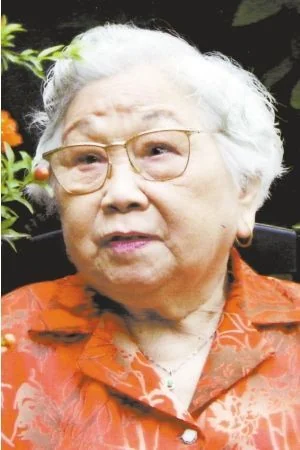
The hand behind the hollow trunk came from a family of potters. Born in 1919 in Qianluo, Yixing, Jiang Rong learned from her father in childhood and later from her uncle, Jiang Yanting, according to Hong Kong’s museum. The individual style of this water dropper grew from that family training.
Wuxi Museum describes her work through forms drawn from plants and animals, and explains how potters select and adapt natural shapes to make usable vessels. On Jiang’s water dropper, color and shape give wood, insect, and toad different appearances within one small composition.
Naturalism here involves choosing what makes each form recognizable. The trunk has its rings, the insect its thin limbs, and the toad its heavier outline. I like how each receives a different kind of attention. The broad cut end establishes the piece of wood quickly, leaving the smaller creatures to slow the looking down.
Jiang’s water dropper gives that careful looking somewhere to settle. After following the insect’s legs and the toad’s head, I return to the dark opening in the trunk. The opening brings the little outdoor scene back to the writing desk, where the vessel’s water and its modeled creatures share the same body.