The China Dish journal / A closer look
What Is Frit in a Pottery Glaze?
Learn why potters add powdered glass to a glaze, how frit is made, and what the frit number and firing cone tell you when reading a ceramic recipe.
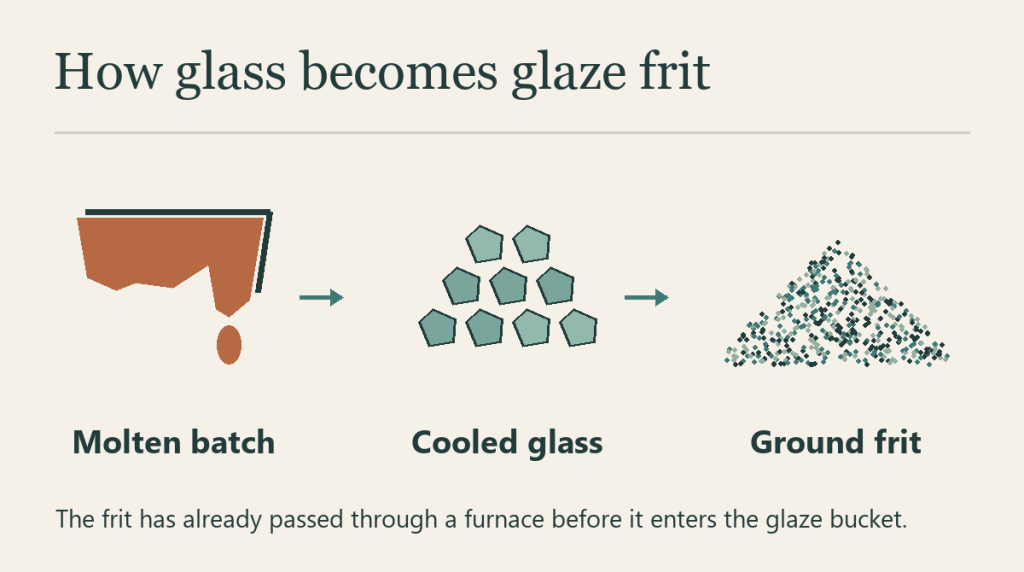
Frit is glass made to a particular recipe, cooled quickly, and usually ground into powder. When a potter weighs out a material labeled Ferro Frit 3124, that powder has already been through a furnace. Its next job is to melt with the other glaze ingredients and help form the coating on a cup or bowl. The number matters. In one firing test, two closely related frits flowed quite differently at the same temperature.
Why melt the ingredients before they reach the potter?
Consider what happens in a bucket of ceramic glaze. The potter needs particles to stay distributed through water long enough to coat the clay evenly. Some raw boron compounds dissolve in the water and change how the mixture pours or settles. Yet boron is valuable in the kiln because it helps a glaze melt. A frit maker can put the boron into glass first. That glass dissolves very little in water, so the potter can introduce boron as a solid ingredient in the glaze.
Making that glass takes a separate firing. ANFFECC, the Spanish association of ceramic frit and glaze manufacturers, describes factories weighing and mixing raw materials, melting the batch, then rapidly cooling the molten stream as it leaves the furnace. Water is commonly used at the outlet. The cooled glass can then be ground. The association gives a furnace range of 1,200–1,500°C (about 2,190–2,730°F) for producing frit. The potter chooses a firing schedule later, once the frit, the rest of the glaze recipe, and the clay body are known.
The cooling method affects what happens next. Water-quenched frit needs to dry before packing. Air-cooled frit can go straight to the packing stage.
What changes in the glaze kiln?
Digitalfire placed a magnesium-rich frit and talc in the kiln to see how each behaved on its own. At cone 06, Ferro Frit 3249 had spread into a glossy pool on its white tile. The talc kept its rounded shape even at cone 6, a considerably hotter firing. Both materials supply magnesium oxide to glazes. In talc, the magnesium starts out bound in a mineral crystal. In the frit it is already part of a glass that softens readily.
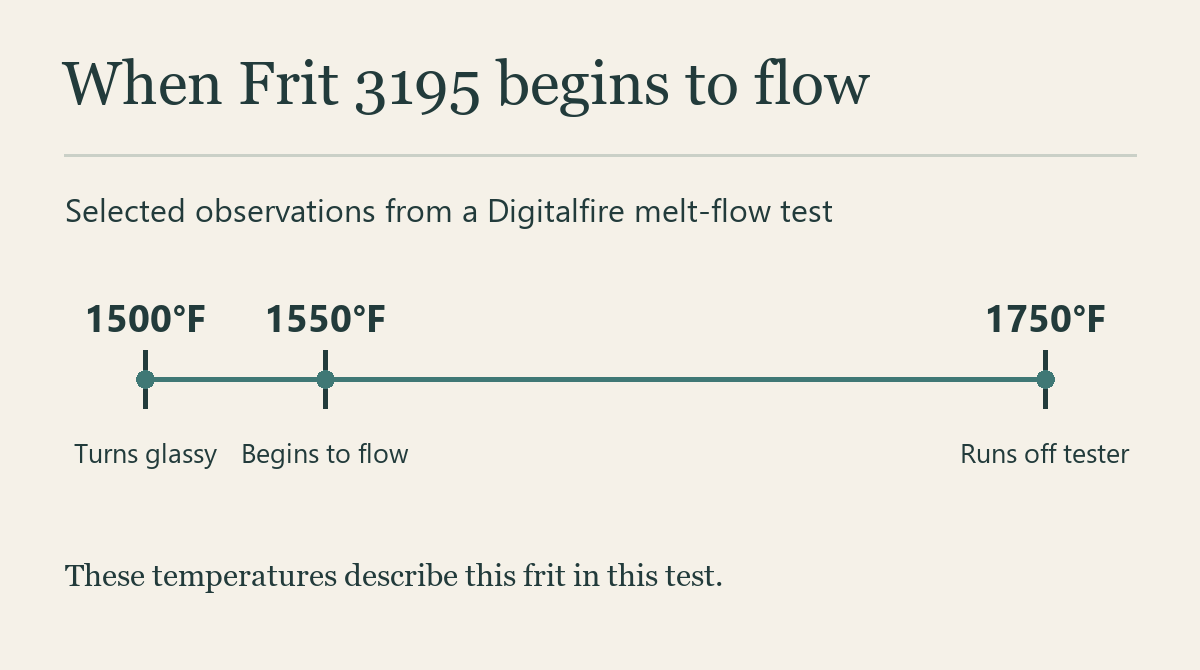
Softening happens over a range. In a separate test, Digitalfire fired Ferro Frit 3195 samples at successively higher temperatures. A glassy surface appeared before the sample began to run. The distance it traveled down the tester increased as the temperature rose.
That difference carries through to a whole glaze. Digitalfire also compared two cone 6 recipes with nearly the same calculated proportions of oxides. One got its sodium and potassium from feldspar and much of its magnesium from talc. The other used frits to supply those ingredients. Both glazes reached the lip of the tester, but only the frit-supplied version left a long trail down the slope. The oxide list tells you what goes into the glass. The trail tells you how freely this particular batch moved during firing.
Why does a recipe specify the frit number?
Return to Ferro Frit 3124 and its close relative, 3134. Digitalfire compared them at 1,800°F (about 980°C). The sample of 3124 contained about 10% alumina, the ceramic name for aluminum oxide. The 3134 sample contained essentially none. Alumina gives molten glaze more resistance to flow, and the alumina-poor sample ran farther. That matters on the upright wall of a cup, where gravity keeps pulling on the coating while it is fluid.
A potter can also supply alumina through clay. If a glaze needs clay to help its particles stay suspended in the bucket, a frit low in alumina can leave room for that clay in the recipe. In a different batch, the potter may want the frit itself to carry more alumina. Swapping one numbered frit for another can therefore mean recalculating the clay and silica as well.
How to read the frit line in a glaze recipe
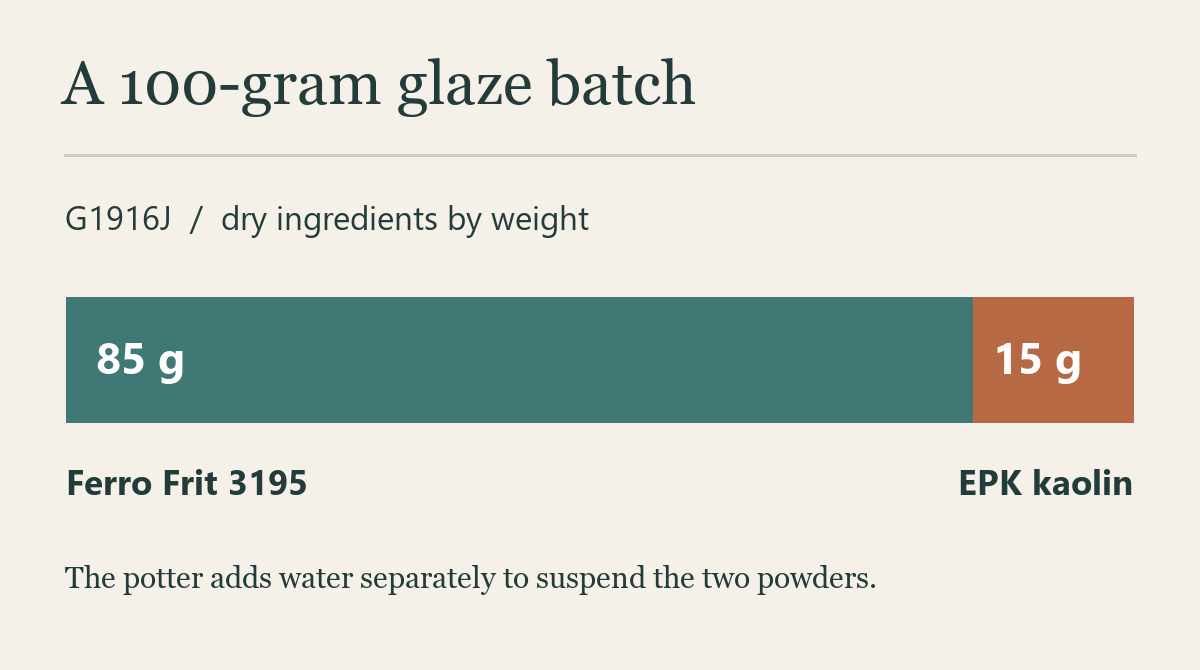
One of Digitalfire’s transparent low-fire glazes, G1916J, has just two dry ingredients. In a 100-gram batch, 85 grams are Ferro Frit 3195 and 15 grams are EPK kaolin, a fine white clay. Water is added separately. The kaolin helps keep the frit suspended so that a potter can pick up an even coating. In the kiln the two ingredients melt together. Digitalfire describes the resulting cone 04 glaze as transparent, with a slightly matte finish.
Even a clear surface leaves one question open. On a test mug made from Plainsman Buffstone clay, the glaze came out of the kiln looking intact. A later thermal stress test revealed a network of fine cracks. Digitalfire adjusted the recipe by replacing some of the 3195 with a lower-expansion frit so that the glaze would fit that particular clay better as both cooled. Buffstone mug and recipe adjustment
Read the original recipe again and three numbers now have distinct jobs. 3195 identifies the glass the potter weighed out. 85 gives its share of the dry batch. Cone 04 describes the firing in which that batch became a glaze on the pot.