The China Dish journal / A closer look
Qianlong’s Yixing Zisha Inkstone Set: Mixed Clay and Covers
Qianlong’s Yixing inkstone set contains six ceramic inkstones made by blending Yixing zisha clay with refined chengni clay. Dated by the Palace Museum to 1775, the set pairs earlier inkstone designs with jade-inlaid wooden covers. Its mixed clay, six forms and fitted boxes offer three different ways to understand an imperial writing tool. Why add […]
Qianlong’s Yixing inkstone set contains six ceramic inkstones made by blending Yixing zisha clay with refined chengni clay. Dated by the Palace Museum to 1775, the set pairs earlier inkstone designs with jade-inlaid wooden covers. Its mixed clay, six forms and fitted boxes offer three different ways to understand an imperial writing tool.
Why add Yixing zisha to a chengni inkstone?
The clay blend connects this set to Yixing, the Chinese pottery center associated with zisha, or purple-sand clay. Its other material is finely filtered clay used to make fired inkstones, known as chengni (澄泥). An inkstone provides the surface for grinding ink; here that surface is a ceramic body.
The Palace Museum explains that adding zisha gave the clay a subdued purple cast and increased friction during grinding. That explanation concerns how the working surface takes ink. The museum leaves the proportions unspecified, so the useful distinction is the combination of materials and its stated purpose, rather than a recipe to reproduce.
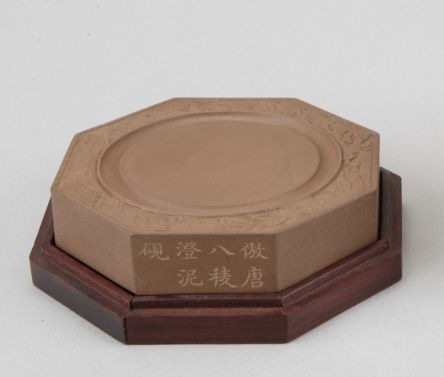
The uncovered octagonal piece is about 3.9 inches (10 cm) across and 0.8 inches (2 cm) high. A broad, shallow circle sits inside its eight-sided outline, with a narrow band of ornament following the rim. I find that separation helpful: the outline gives the object its character, and the open central area explains its task.
The set occupies one small corner of Yixing’s wider object culture. The Yixing reading outline places studio objects alongside clay color, teapot decoration and sculptural forms.
Six Qianlong inkstones shaped after earlier models
The shared clay blend takes six different shapes, each identified in its inscription as an imitation of an earlier inkstone. Those historical references reach back to Han, Tang and Song models. For this set, the names describe what eighteenth-century makers were looking back to.
The grinding area and ink reservoir also vary. The grinding area is the open part where ink is worked, while a reservoir is a recess for holding ink. The Palace Museum’s descriptions let us compare those parts even when the fitted covers conceal them.
| Earlier model named for the inkstone | Form and working surface described by the museum |
|---|---|
| Tang octagonal chengni inkstone | Eight sides surround a circular grinding area. |
| Song Jade Rabbit inkstone | A round face carries a rabbit design and has no ink reservoir. |
| Song feng-character inkstone | The outline follows the Chinese character feng (风), meaning wind; its reservoir is crescent-shaped. |
| Han Shiqu Pavilion roof-tile inkstone | A rectangular body contains a circular grinding area. |
| Han Weiyang brick inkstone, with a moon rising over the sea | An oval body has a shallow moon-shaped reservoir. |
| Song Deshou Hall patterned inkstone | A rectangular body has a bottle-shaped grinding area, with the bottle’s mouth forming the reservoir. |
I don’t treat the dynasty names as the ages of these six objects. As a former museum guide, I care about that distinction because an old shape can travel into a much later object. The Palace Museum’s English exhibition account places Qianlong’s interest in earlier designs within his broader collecting and commissioning of inkstones.
The inkstone set’s 1775 date and its Suzhou commission
The earlier models belong to the set’s design history; its manufacture belongs to Qianlong’s reign. The museum dates the set to 1775, his 40th year, from the yiwei (乙未) designation in its inscriptions. There’s a second date, 1779, his 44th year, attached to archival evidence about his liking for chengni clay mixed with Yixing zisha.
The two dates answer different questions: the inscriptions establish the date assigned to this set, while the later archive connects the material to inkstones used for imperial annotations in red. It’s possible to understand both without moving the manufacture forward by four years.
Production also involved two locations. Suzhou makers executed the set according to court designs, and inscription specialists in the imperial workshops then engraved the inkstone names and Qianlong’s texts. The emperor’s words, the objects’ making and the cutting of the inscriptions were distinct contributions to the finished set.
Jade and gilt writing on the inkstone covers
The completed inkstones each have a fitted wooden box, so their inscriptions appear within a larger arrangement of wood, jade and clay. In the group view below, the six covers carry pale jade inlays above gilt writing. The varied outlines are visible, but the grinding areas remain underneath the covers.
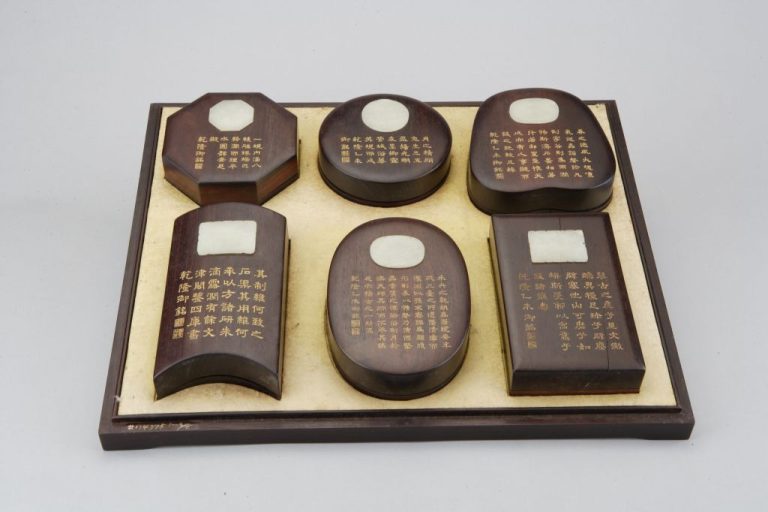
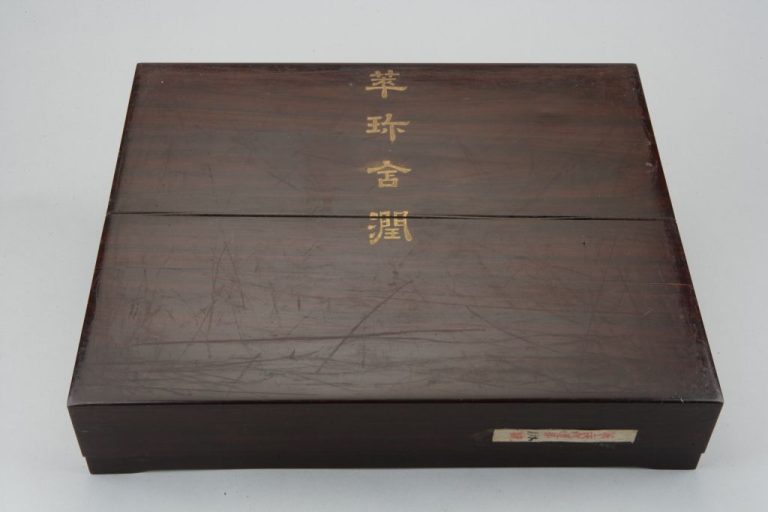
The museum identifies the individual boxes and large outer box as zitan, a prized dark wood used for court furnishings and small objects. Each cover bears a jade inset with carved decoration, and the whole set fits inside the outer box. Its closed lid gathers the six separate forms into one plain rectangular shape.
The Palace Museum’s collection entry supplies the individual names and inscriptions for closer comparison. The photographs give a useful starting point: on the octagonal inkstone, the circle is a working area; on the round wooden cover, the pale oval is an inset. Once those surfaces are separated, the clay tool and its elaborate housing become easier to read together.