The China Dish guides
Yixing clay & teapots
Yixing pottery is the ceramic tradition of Yixing, a city in China’s Jiangsu province. Its purple-clay ware, called zisha (紫砂), includes teapots and objects for the writing desk. The name covers a wider world than a purple teapot: brown and red vessels, modeled plants and small tools for preparing ink all belong in the picture.
Clay, shaping and surface give us a way through that variety. I’ll follow those connections from the pottery town of Dingshu to the work of potters and writers, then to the water dropper and inkstone beside a brush.
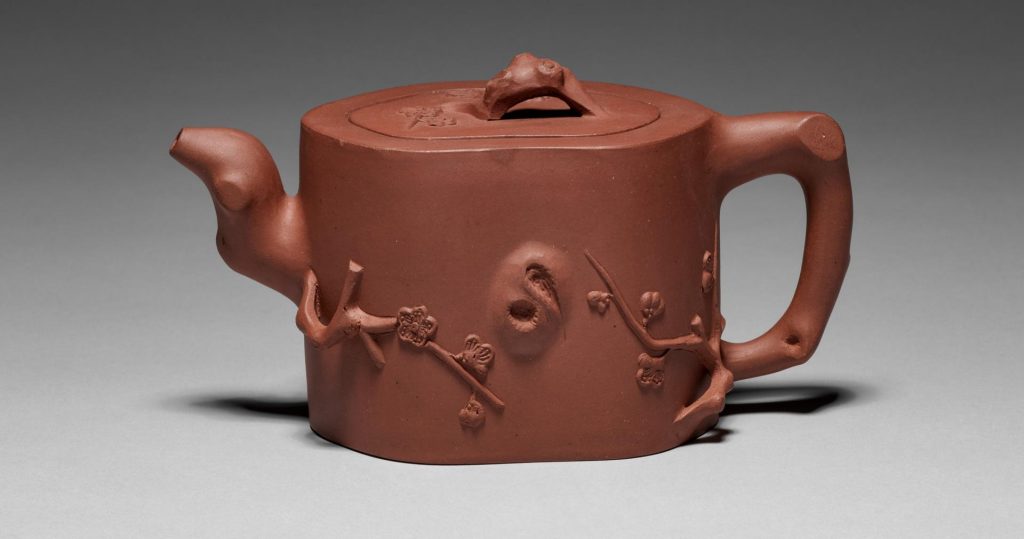
A few details to notice
Look a little closer.
Read the object account and sources ↘
Read the object account and sources ↘
01 / A closer look
Why is purple clay not always purple?
- Clay & color
- Form
- Written surfaces
Yixing clay colors include brown, red and yellow-buff. Different materials and mixtures help explain that range.
Yixing clay colors: purple, red and yellow-buff variation ↗
From the referenced guide section and its sources.
02 / A closer look
What do the words on a teapot do?
An inscription may be a pot’s name, a poetic text, a dedication or a maker’s mark. Its position helps distinguish those roles.
From the referenced guide section and its sources.
03 / A closer look
Who helped shape the object?
In Chen Mansheng’s circle, the potter, designer and writers could be different people. A name on a pot can lead into a collaboration.
Yixing Teapots and Literati Culture: Chen Mansheng’s Circle ↗
From the referenced guide section and its sources.
A useful comparison
Look at each part of a Yixing object
| Detail | Reading route |
|---|---|
| Body color | Clay groups, mixtures and fired colors |
| Written surface | Name, poetic text, dedication or mark |
| Form and inscription | Potters, scholars and collaboration |
01 / The guide
Yixing pottery connects a place with several kinds of object
Yixing names a place before it names a kind of pot. Dingshu, within Yixing, is a center of the local pottery tradition. Keeping that geographical meaning in view helps separate three questions: where an object belongs, what material it uses and what the finished object does.
- When a teapot carries words↗
A teapot’s written surfaces.
- Jiang Rong’s Zisha Water Dropper: Toad and Mole Cricket↗
A water dropper for the writing desk.
Read the full section
Zisha is the material and ware name closely associated with the region. The English translation, purple sand, can make the clay sound like a single color or loose grains. In an object description, however, the name points to a clay tradition. The clay becomes a vessel through preparation, forming and firing.
Tea brought that material into a long relationship with use and collecting. China’s National Intellectual Property Administration places the development of zisha teaware within the Ming and Qing dynasties. A teapot could serve tea while also offering a surface for modeled decoration, writing and a maker’s mark.
The wider local pottery industry also includes other wares. Wuxi’s heritage account distinguishes Yixing Jun pottery, with glaze and applied clay decoration, from its account of purple-clay making. A guide to zisha therefore opens one part of Yixing’s ceramic world; it doesn’t describe every ceramic made in the city.
I find the distinction easier to hold onto when the object has a job attached to it. A teapot contains and pours tea, a water dropper supplies water for writing, and an inkstone provides a grinding surface. A shared material can take quite different shapes as those tasks change.
02 / The guide
Purple clay describes more than a purple surface
Within the zisha tradition, the material name and the visible color tell different parts of the story. Brown, red and yellow-buff all occur in the palette discussed by the Flagstaff House Museum of Tea Ware. Purple clay needn’t look like the bright purple of a painted color chart.
- Yixing clay colors: purple, red and yellow-buff variation↗
Clay groups, mixtures and naming stages.
Read the full section
The museum’s exhibition groups its materials as purple, red and yellow-buff clay. Those clays can be used separately or combined, and mineral colors can extend the range. A finished shade is therefore a result to describe, while a recorded clay mixture tells us about a choice made before the object was complete.
Clay names can also refer to different stages. Liu Fei’s discussion on China’s intangible cultural heritage website includes names drawn from the raw mineral’s appearance and from its color after firing, so reading both as colors of finished pots would mix up two stages of making. Place and position within a deposit can enter the vocabulary too.
For a reader, that means brown is a clear observation but an incomplete material history. The next piece of information might come from a maker’s record, a collection entry or a description of the prepared clay. Looking closely starts the inquiry; the record connects what we see with what we can say about it.
The separate guide to Yixing clay colors follows the clay groups, mixtures and naming stages in more detail. Here, the distinction lets us move from the appearance of clay to the work of shaping it.
03 / The guide
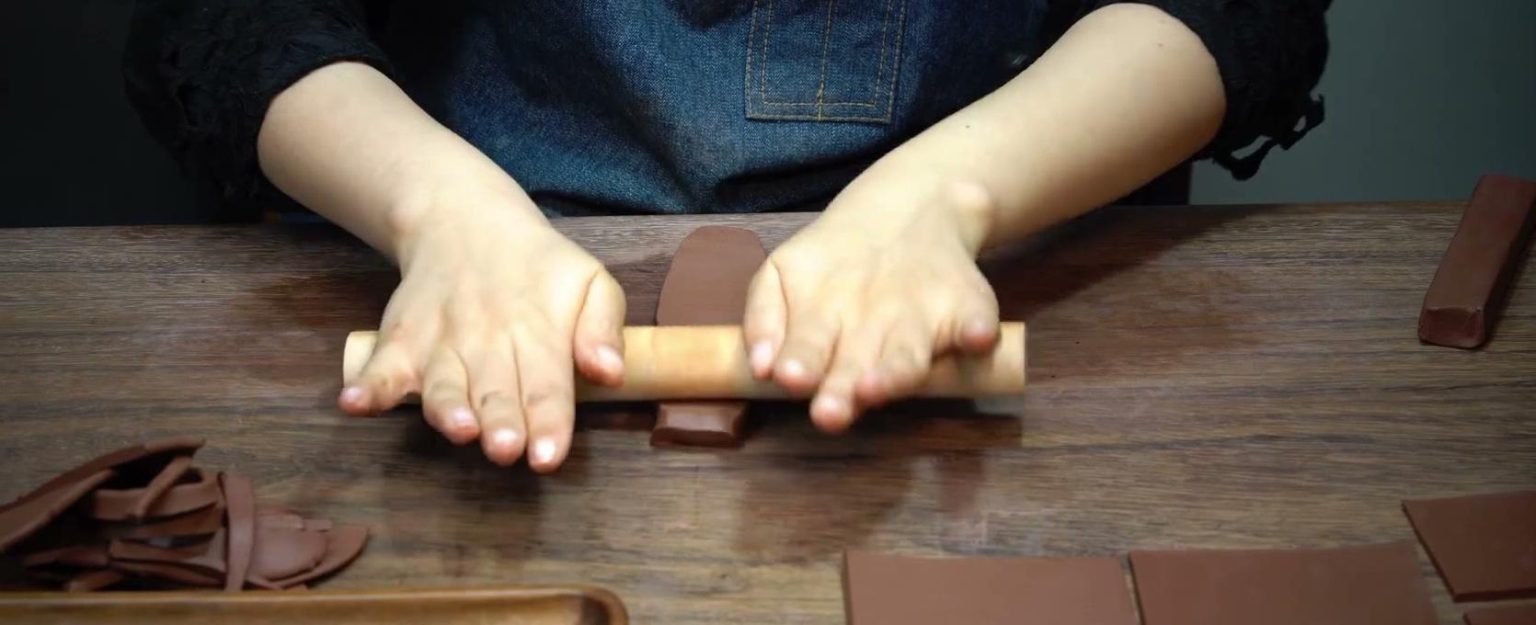
Building a Yixing teapot from clay slabs
A prepared slab gives the clay a different starting shape from a lump. Wuxi’s account of purple-clay craft includes slab preparation, shaping the body, finishing the surface and carving decoration. These are separate kinds of work, even when the finished pot presents them as one continuous form.
Read the full section
The body provides the vessel’s main volume. Its wall, opening and base establish a shape to which the pouring and handling parts belong. A spout and handle may draw the eye first, but their relationship makes sense through the body between them. The lid adds another meeting of edges at the top.
Surface finishing has its own task. A rounded wall can carry light across a broad curve, while an edge gives the eye a sharper change of direction. Carved decoration then introduces marks into that surface. Forming a wall and cutting a line into it leave different kinds of visible result.
Firing turns the shaped clay into ceramic. A finished teapot therefore carries several decisions together: the prepared material, the form given to it and the treatment of its surface. A smooth exterior alone tells us little about the whole sequence that produced the vessel.
The body, spout and handle give me a way to connect making with looking. Following the curve from the belly toward the mouth, then comparing the handle and spout, keeps the separate parts in view. It also gives the next question some substance: what happens when those parts become ribs, petals or stems?
04 / The guide
Plain, ribbed and naturalistic Yixing forms
The shaped body can carry its design through a plain contour, repeated ribs or forms drawn from nature. Wuxi’s heritage account describes plain, ribbed and floral designs within purple-clay pottery. Each directs attention toward a different relationship between the vessel’s volume and its surface.
- Jiang Rong’s Zisha Water Dropper: Toad and Mole Cricket↗
A naturalistic water dropper: trunk, toad and mole cricket.
Read the full section
A plain pot leaves more of the work to its outline. The swelling of the body, the height of the lid and the reach of the spout become easier to compare when the wall carries little raised ornament. Plain describes that treatment of the surface; it still leaves plenty of decisions in the shape.
Ribs divide a surface into repeating sections. The eye follows a series of raised and recessed parts instead of moving across one broad wall. Repetition can tie the body and lid together, so the divisions are worth following around the vessel as well as across its front.
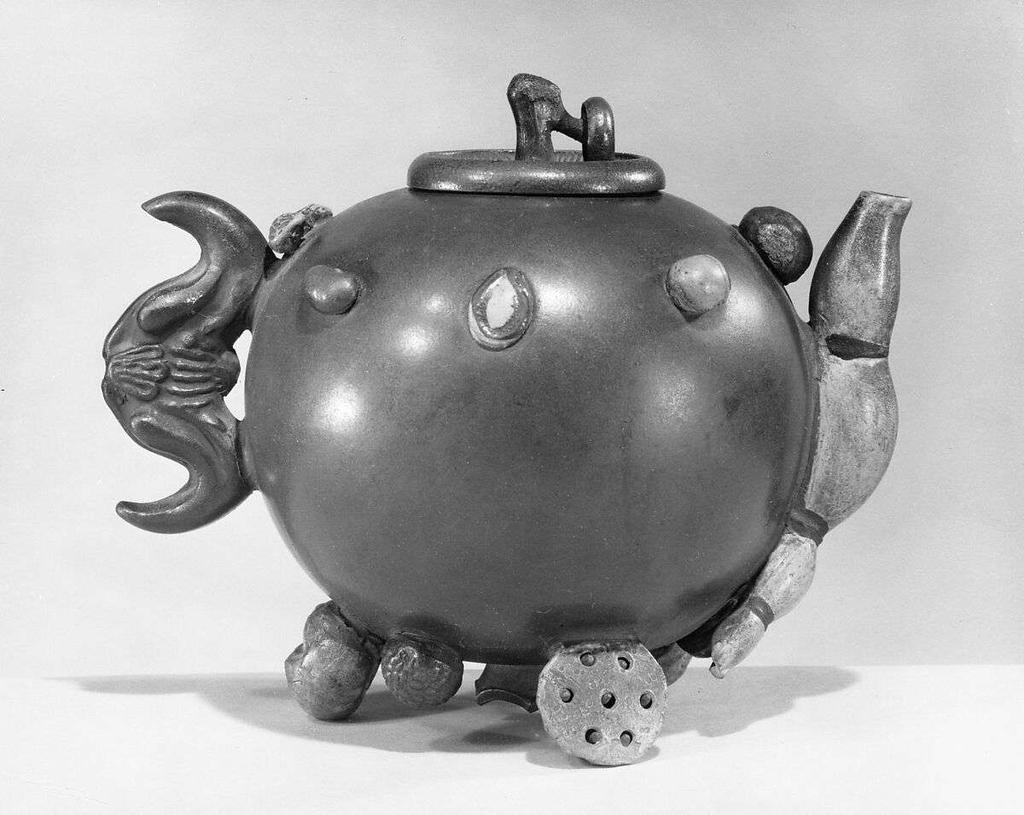
Naturalistic work draws on recognizable plants, fruit, wood or small creatures. When a stem supplies the curve of a handle and a fruit supplies the outline of the body, the borrowed forms help the parts belong together while still leaving a pot to hold and pour water. The interest lies in that meeting of the plant and the working vessel.
| Treatment | A detail to follow | What it draws attention to |
|---|---|---|
| Plain contour | The turn from belly to shoulder | The body as a continuous volume |
| Ribs or segments | A repeated ridge and recess | Rhythm across adjoining surfaces |
| Naturalistic form | A stem, petal or piece of wood | The meeting of a recognizable subject and a vessel |
Plain, ribbed and naturalistic forms offer ways of looking, rather than grades of workmanship. I enjoy a quiet contour for a different reason from a modeled creature. The first gives me a curve to follow; the second asks me to recognize a form and discover how it belongs to the object.
05 / The guide
Scholars brought writing into Yixing teapot design
An open clay wall also gives writing a place in the design. A name, a poetic text and a maker’s mark can occupy different surfaces and perform different tasks. The words have meanings, but their scale and placement also change how much of the clay remains open to view.
- When a teapot carries words↗
Names, inscriptions and marks on separate surfaces.
- Yixing Teapots and Literati Culture: Chen Mansheng’s Circle↗
Potter, designer and writers in Mansheng’s circle.
Read the full section
Calligraphy concerns the forms of the written strokes. A short name in large characters makes a different visual field from several columns of smaller writing. In teapot inscriptions, the open clay wall and the written text are read together on a Palace Museum vessel.
The people behind those marks can have separate roles as well. In a teapot recorded by the Hong Kong Museum of Art, Yang Pengnian’s name, Chen Mansheng’s studio name and an inscription by Guo Lin meet on one object. The collection record connects pottery, design and writing through named participants.
That collaboration is one way to understand literati culture, the cultural life of scholars and writers. A vessel could draw their poetry, calligraphy and interest in seals into the potter’s work. Chen Mansheng’s circle offers a closer account of those relationships and the surviving pots associated with them.
For me, the named participants make the clay wall more interesting to read. The record lets me follow a potter, a scholar’s studio and a writer without folding their contributions into one signature. The same care with names helps explain why a writing desk belongs in this story.
06 / The guide
Yixing pottery beyond tea: water droppers and inkstones
The connection with writing extends beyond words carved on a teapot. A scholar’s desk needed objects that helped prepare ink, including a container for water and a surface for grinding an ink stick. Clay could supply those working forms as well as a vessel for tea.
- Jiang Rong’s Zisha Water Dropper: Toad and Mole Cricket↗
The water vessel beside brush and ink.
- Qianlong’s Yixing Zisha Inkstone Set: Mixed Clay and Covers↗
The ceramic grinding surfaces and fitted covers.
Read the full section
Jiang Rong’s hollow-trunk water dropper is a small example with a clear purpose. The Hong Kong Museum of Art identifies it as a studio utensil and describes a toad and mole cricket around the trunk. A form drawn from nature becomes a container with a task beside brush and ink.
Jiang’s approach also has a family history. The museum records that she learned pottery from her father, Jiang Honggao, and later from her uncle, Jiang Yanting. Her work with natural forms belongs to that learning and her own practice. The closer reading of Jiang Rong’s water dropper follows the trunk, creatures and function together.
An inkstone makes a different demand on clay. The Palace Museum records a court set combining Yixing zisha with finely filtered clay called chengni (澄泥). The ceramic grinding surfaces sit within fitted wooden boxes. Material, working area and housing are separate parts of the object, each with a role to understand.
The mixed-clay inkstone set shows how far a Yixing material can travel from the familiar teapot outline. Its grinding surfaces belong to writing, while the water dropper supplies water. Together, the two objects give the desk its own place within the pottery tradition.
I keep those tasks beside the material names when reading Yixing pottery. Clay tells one part of the story, shaping another, and the object’s use gives both a purpose. A pot’s written wall and a water dropper’s hollow body then become easier to understand as different choices within a shared craft.
Published · Updated