The China Dish journal / A closer look
Two Rongchang Pottery Types: Unglazed and Glazed Ware
Rongchang pottery has two named surface traditions: unglazed nijing huo and glazed youzi huo. Unglazed ware can still carry carved patterns. The distinction concerns the finish. Carving, colored glaze and deliberately bare areas show how much these surfaces can vary. What separates nijing huo from youzi huo? The two names belong to Rongchang pottery around […]
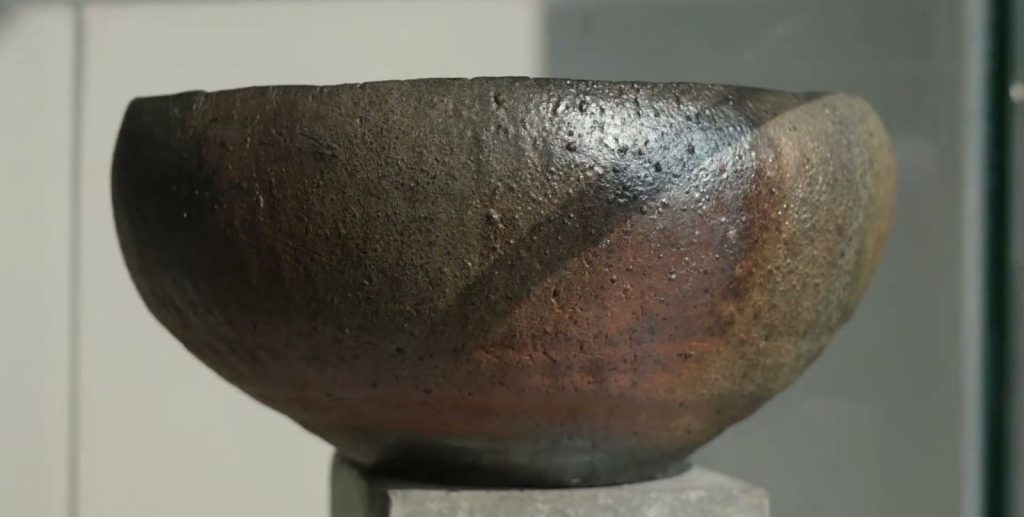
Rongchang pottery has two named surface traditions: unglazed nijing huo and glazed youzi huo. Unglazed ware can still carry carved patterns. The distinction concerns the finish. Carving, colored glaze and deliberately bare areas show how much these surfaces can vary.
What separates nijing huo from youzi huo?
The two names belong to Rongchang pottery around Anfu in Chongqing, southwestern China. The local term nijing huo (泥精货) identifies ware fired without an applied glaze; youzi huo (釉子货) identifies glazed ware. Their difference begins at the surface of the finished object.
Glaze is the coating fired onto a ceramic surface, while the body is the clay structure underneath. With nijing huo, the body and its worked decoration remain central to the appearance. With youzi huo, a glaze supplies another surface, bringing its own colors and effects. Both belong to a tradition that makes useful vessels as well as art objects.
| Rongchang name | Surface distinction | What to look for in the description |
|---|---|---|
| Nijing huo | Fired without an applied glaze | Clay color, carving and other work on the body |
| Youzi huo | Finished with glaze | Glaze color and decoration associated with the glazed surface |
I use these names to understand the finish before considering the pattern or vessel form. They give me a useful distinction between surfaces, rather than two levels of artistic quality. The local pottery reading outline places both within the site’s Rongchang topics.
Nijing huo: carving without a glaze
An unglazed Rongchang surface can be decorated, so “unglazed” tells only part of its appearance. Nijing huo includes plain fired bodies as well as red-clay bodies decorated with white clay slip and carving. Slip here means a clay-based coating; it gives the maker another material to work across the surface.
Carving can leave a cut line or raise a pattern by removing the surrounding clay. Those are different relationships between the design and its background. A sunken line draws the eye into a groove, while a raised motif projects from a surface pared away around it. The distinction helps explain what “carved” can mean on a vessel.
The two small jars below make patterned surfaces easy to follow. Pale bands wrap around their rounded bodies, with narrow lines near the shoulders and angular designs across the middle. I keep looking at the right-hand jar’s changes of direction: a long horizontal line turns sharply while the wall continues to curve.
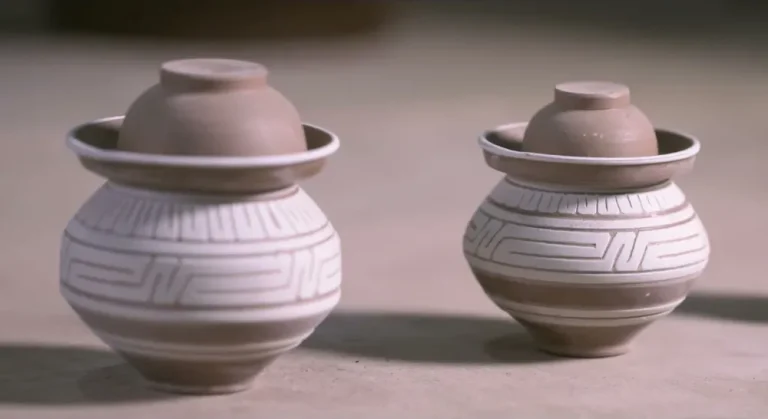
On these jars, the narrow band sits near the shoulder, where the wall bends inward toward the neck, while the broad strip occupies the fuller part of the belly and carries larger angular shapes. My eye follows that broad strip first, then returns to the smaller marks above it. The lines lead around the pot, even where their paths turn sharply.
For nijing huo made with white slip and carving, “bare clay” would miss the work that gives the surface its pattern. The unglazed category leaves room for a maker’s drawn and cut design. A coating of white clay can make that worked decoration distinct from the red body beneath it.
Youzi huo: color in the glazed surface
Youzi huo brings glaze into that relationship between body and decoration. Rongchang’s glazed wares have a range of colored finishes, including red, yellow, green and black. The national heritage account also describes underglaze decoration, where a painted design sits beneath the covering glaze.
A colored glaze and a painted motif do different jobs. One can give the surface its overall color; the other gives it lines or images to read. An object description becomes more useful when it distinguishes those contributions, even though the eye takes in the finished surface all at once.
The darker vessels below draw my eye to light. On the small covered pot in front, a pale patch curves across the shoulder and fades down the wall, while thinner gleams run along the cup rims beside it. I can follow those bright edges easily; the green and brown surfaces between them are much quieter.
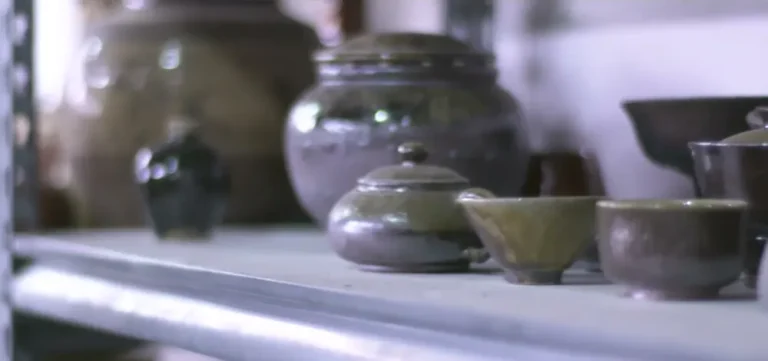
A photograph lets me study the distribution of light, while a maker’s or collection’s description identifies the finish. I wouldn’t name a glaze from a reflection alone. Knowing the glaze’s recorded color then adds context to the bright patch, so the finish and the vessel’s curve can be appreciated together.
Rongchang decoration where clay and glaze meet
A glazed Rongchang vessel can also contain deliberately unglazed areas within its design. In the local paper-cut decoration method, paper covers selected parts of the body during glazing. Removing the paper leaves those areas without the applied glaze, so the reserved pattern and the glazed background share one surface.
The method changes the question from “which color?” to “where does the glaze stop?” A flower or line can be defined by the part left uncovered. The surrounding coating helps give the design its edge. I find that meeting especially interesting because a quiet patch of clay can be an active part of the decoration.
Rongchang designer Zhong Dejiang faced a related problem when preparing decorated wares for repeated production. Different workers’ hand-carved patterns were difficult to keep consistent. He developed cut-paper templates to help repeat the designs. The pattern therefore belonged to a design problem as well as to an individual vessel.
Zhong’s story gives the repeated lines another dimension. A motif can carry a maker’s choice and still be prepared for several workers to execute. The paper supplies a repeatable outline; the rounded pottery gives that outline a surface with depth and curvature. The two contributions meet in the completed design.
On a reserved pattern, the edge is where the distinction becomes visible: glaze reaches one area, and worked clay remains in another. I can follow the border as it travels around a shoulder or belly. The local names introduce the finish; the pattern’s boundary gives that finish a particular shape.