The China Dish journal / A closer look
Rongchang Clay: Red and White Bodies, Marbling and Glaze
Rongchang clay comes in local red and white varieties. After firing, the pottery body can be ocher-red or ivory-white; combining the clays can also produce a marbled pattern. Those material colors tell one part of a vessel’s story, while decoration and glaze give its surface another. The useful distinction is between the material before firing, […]
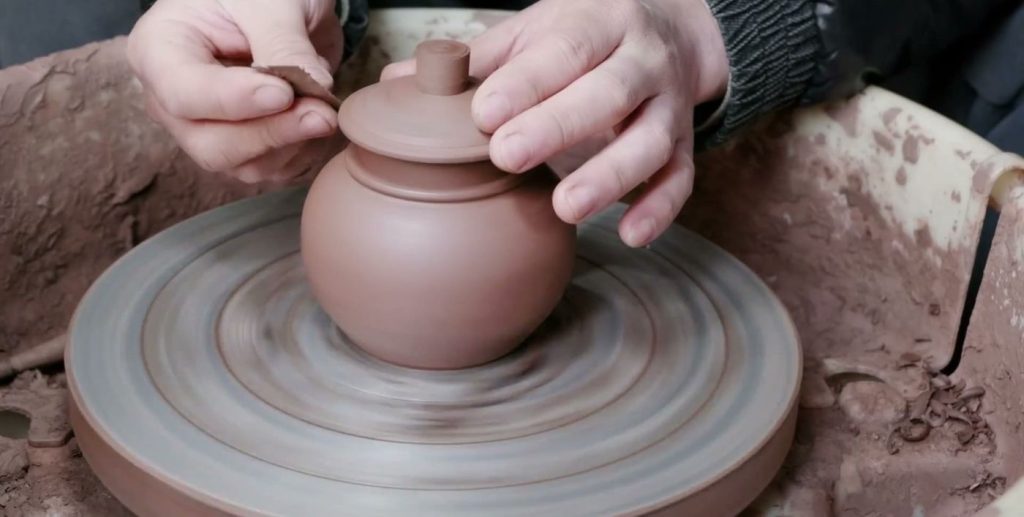
Rongchang clay comes in local red and white varieties. After firing, the pottery body can be ocher-red or ivory-white; combining the clays can also produce a marbled pattern. Those material colors tell one part of a vessel’s story, while decoration and glaze give its surface another.
The useful distinction is between the material before firing, the fired body and the surface we see. A potter’s marbled vase helps connect those stages with the work of making a vessel, before we turn to reading the colors on finished wares.
Rongchang red and white clay: from shale to a fired body
Rongchang’s red and white clays belong to a local pottery tradition around Anfu in Chongqing, southwestern China. The national heritage description identifies the main body material as Jurassic sedimentary clay shale. Here, “body” means the clay structure that forms the vessel, including the walls beneath any surface coating.
The same account describes the fired bodies as ocher-red or ivory-white. Ocher-red suggests an earthy red-brown; ivory-white is a warm white. I find those quieter color words helpful: imagining bright scarlet and pure white makes the material sound more like a pair of paints than pottery clay.
| What the color description refers to | Colors in the heritage account |
|---|---|
| Local raw clay shale | Red and white |
| The pottery body after firing | Ocher-red or ivory-white |
A color description becomes clearer when its stage is named. “White clay” identifies a raw material; “ivory-white body” describes a fired result. Our Regional Chinese pottery outline places this material question alongside other local traditions, where the clay and its treatment have their own histories.
Red and white clay together: Diao Xianchao’s marbled vase
Red and white clay can also enter the same vessel. Rongchang potter Diao Xianchao works with a marbling technique called jiaoni, which brings white clay into red clay during forming. A 2023 Rongchang Daily profile describes his work on controlling the resulting patterns and shapes.
Diao’s workshop photograph shows a small tool touching the shoulder of a brown vase. The vessel narrows toward its neck before opening into a flared rim. Knowing whose hands are at work gives the material discussion a person, even though the vase’s brown surface leaves its exact clay mixture unanswered.
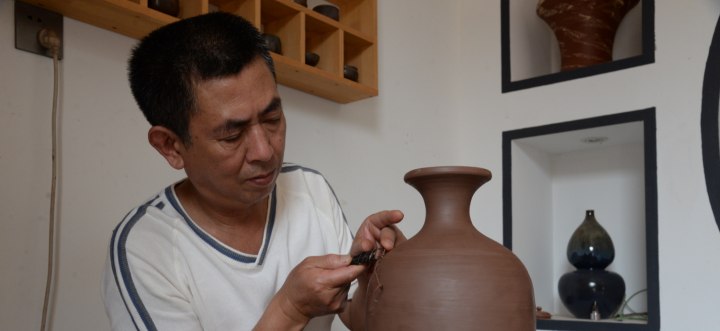
One of Diao’s designs made the relationship between the clays especially demanding. In 2019, he developed a vase shaped after a Chongqing hot pot, building its mouth, pot-shaped body and base as separate parts. The upper section used marbled clay, while the lower section used red clay.
The profile records two difficulties: the heavy upper portion could collapse during forming, and the two clay sections shrank differently during firing, leading to cracks and collapse. Diao worked through repeated failures before succeeding. The account gives a particular maker’s problem and result, with the clay combination at the center of both.
I like this example because a pattern stops looking like a purely visual choice. Bringing two colors into a vessel also means making the materials work together. The marbling belongs within the potter’s decisions about the whole form, including the parts that have to survive firing.
Reading Rongchang clay beneath decoration and glaze
A red-and-white pattern raises a further question: where does each visible color sit? Rongchang’s heritage account distinguishes unglazed wares with natural body color from wares decorated with colored glazes. Glaze is a fired surface coating, so its color describes a different part of the object from the clay body underneath.
The small lidded vessels below make the surface question easy to picture. Brown areas alternate with cream-colored bands and angular patterns; the lids repeat the light-and-dark contrast. The visible arrangement gives me plenty to follow with my eye, while identifying the decoration method needs an object record or the maker’s account.
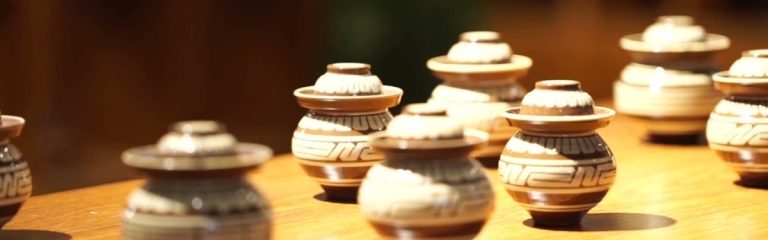
For a labeled object, I would keep the body material and the surface treatment side by side. A record of red clay, white clay or a mixture answers the material question; a record of glaze or another decoration explains the face presented to the eye. A photograph alone can’t establish a chemical recipe or the color through the entire wall.
The angular band on the front-right vessel is where my attention settles. Its line travels around a curved body, changing a simple pale stripe into a pattern. Once the material and surface are separated in the description, that small detail can be enjoyed for what it actually shows.