The China Dish journal / A closer look
Why Metal Mounts Were Added to Chinese Porcelain
A London silver lid, a pair of handles and a jeweled Ottoman ewer show how metal mounts changed the shape and use of Chinese porcelain after firing.
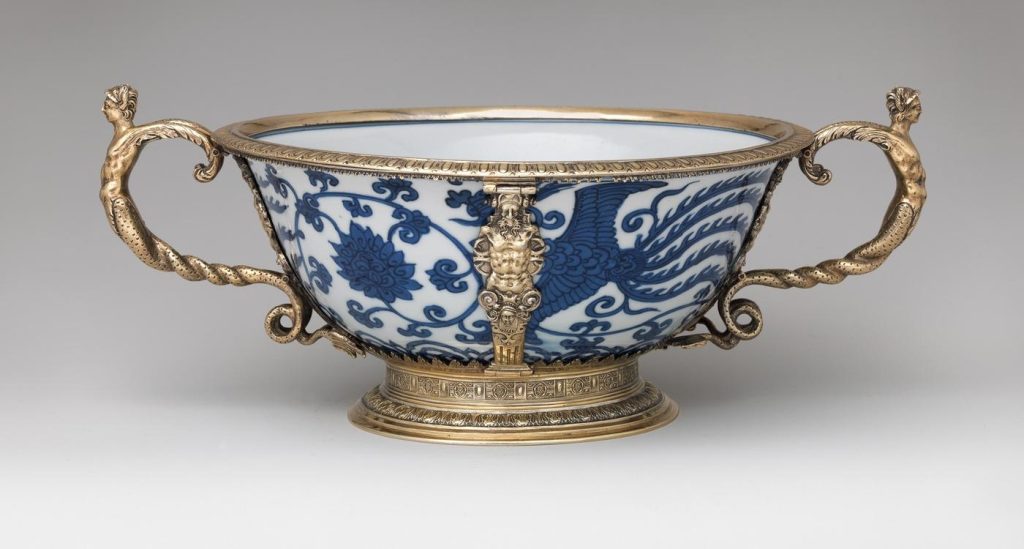
Metal mounts on Chinese porcelain could give a bowl handles, turn a small cup into a covered vessel for a courtly gift, or hide a crack left by firing. A mount is a separate fitting attached to the finished ceramic. To see what it did, follow the outline of a piece until the porcelain gives way to metal. On one red Ming cup, nearly everything above the lip and below the bowl belongs to a London silversmith.
The London silversmith who gave a red cup its cover
Start at the ring on top of the Metropolitan Museum of Art’s Cup and cover. Follow the slope of the lid down to the lip. Only here does the red porcelain appear. It curves inward for a short distance before giving way to the tall metal foot. Cover the lid and foot in the photograph with your fingers and the proportions change altogether.
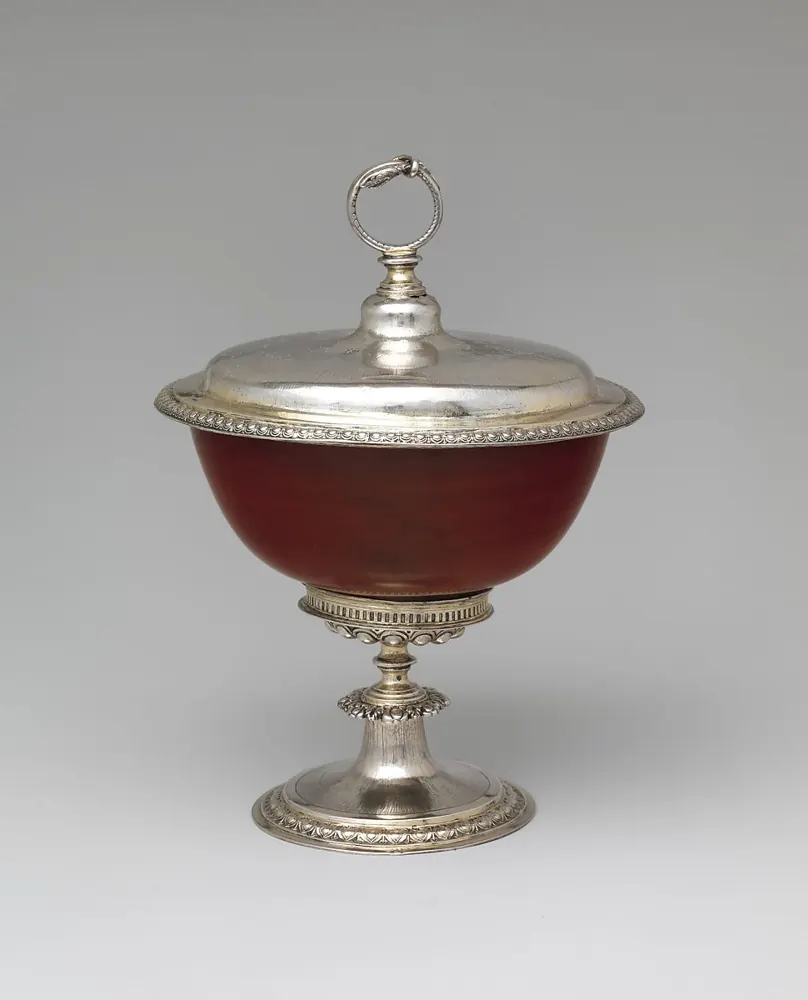
The Met dates the Chinese cup to about 1507–66. Its red glaze once carried a delicate design painted in gold. This kind of decoration, made in China chiefly for buyers in Japan, was known there as kinrande, or gold brocade. Much of the drawing has worn away. The gold on the settings belongs to a second craft. Around 1570, Affabel Partridge made the London mounts of gilded silver, silver with a layer of gold on its surface.
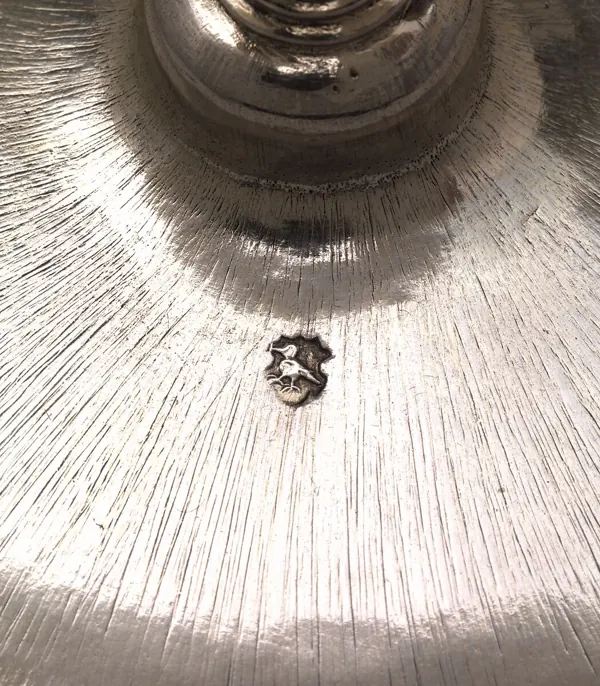
A comparison in the Met’s catalog gives a sense of the company such a cup could keep. In 1582 Elizabeth I received a similar mounted cup as a gift. The two words a similar matter here. They give us a documented occasion for giving mounted porcelain while leaving the first owner of Partridge’s red cup an open question.
Two handles changed the span of a blue-and-white bowl
The two-handled bowl from Burghley House, pictured at the head of this article, gives the hand somewhere new to go. Its ceramic rim measures just under nine inches across. With the London handles, the bowl spans twelve and a half inches (31.8 cm). The difference is easy to miss in a frontal photograph. At the table, a hand reaching for either handle would meet metal well before it reached porcelain.
The museum dates the Chinese bowl to 1573–about 1585 and the London fittings to about 1585. It relates the painted design to wares made for buyers in China. Around that blue brushwork runs a second set of patterns. Metalworkers stamped and cast motifs drawn from classical architecture into the gilded silver. The bowl is a good reason to read the two parts of a museum label separately. Where a silversmith worked tells us little on its own about whom the potter had in mind.
Beneath the silver band on an Ottoman court ewer
The Walters Art Museum’s photographs show a blue-and-white ewer with a long spout, a curved handle, and a narrow band of metal at the foot. Start with the upright view in the museum’s gallery. The band echoes the gilded fittings on the lid. Now choose the view looking straight at the underside of the foot. Walters Art Museum photo gallery, ewer 49.1617
In that photograph, follow the crack upward from the lower edge. It passes through the blue circles around the inscription and nearly touches the metal again on the far side. The four blue characters express a wish for long life, happiness, and honor. The crack and inscription both belong to the porcelain within the band.
During a conservation study, Gregory Bailey examined how that band stayed in place. Ottoman court metalworkers had bent the silver against the foot and secured it with a dark resinous adhesive. The band concealed firing flaws and raised the ewer slightly. Bailey dates the Chinese porcelain to the Wanli era (1572–1620) and places the Ottoman work probably in the late sixteenth to early or mid-seventeenth century.
The jewels posed a different problem. Each setting needed a secure hold on a vessel meant to carry liquid. X-rays revealed short metal posts anchoring the settings. Where settings had fallen away, shallow holes were visible. Bailey found that none of the holes appeared to reach the inside. That left the walls of the pouring vessel intact beneath the stones.
Return to the silver ring around the foot. From the side it looks like a finishing touch. From below you can still see the irregular piece of fired clay that the metalworker had to fit. Those two views together explain something a date on a label can only hint at. Someone in another workshop took this particular ewer, crack and all, and decided it was worth setting with jewels.
For the material and firing behind the red cup, see the guide to porcelain.