The China Dish journal / A closer look
Chinese Armorial Porcelain and the Families Behind the Shields
A Portuguese jug and an English family’s plate reveal how to read Chinese armorial porcelain, from an inverted shield to a married couple’s initials.
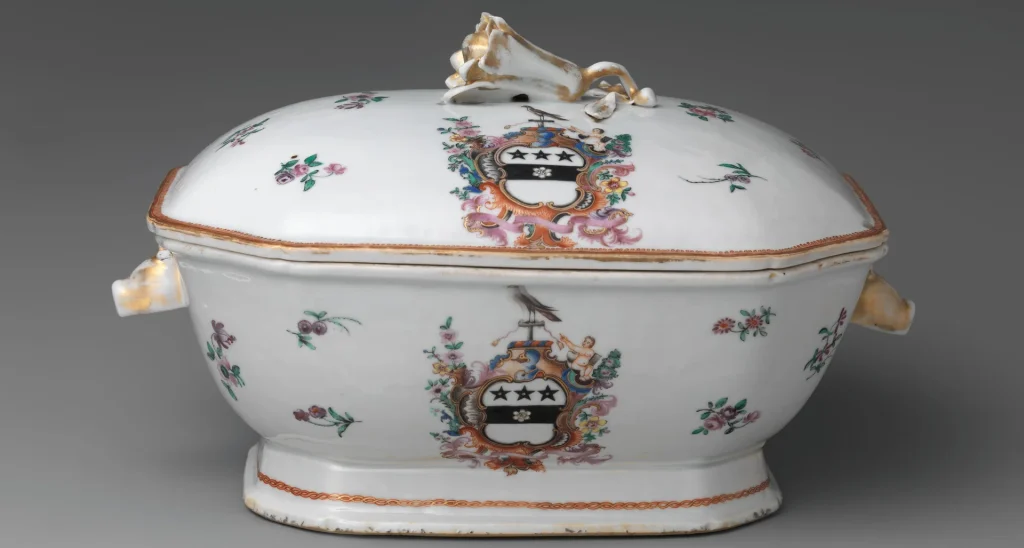
Chinese armorial porcelain is porcelain made in China bearing a coat of arms. A shield painted on a jug from Jingdezhen identifies the Portuguese royal family. On a dinner plate made for an English household two centuries later, a shield brings together two families, and three letters on the rim give the couple’s initials. Both pieces are in the Metropolitan Museum of Art. The plate has an unusual companion in the historical record. The design prepared for its decoration survives.
A Portuguese shield, upside down
The jug stands a little over seven inches tall. Five small blue shields form a cross on its rounded belly. Look closely at the row of three across the middle. The pointed end of each little shield faces the mouth of the jug. That detail helps explain what the Met means when it says the Portuguese royal arms are upside down. The museum interprets the reversal as a painter’s misunderstanding of the emblem.
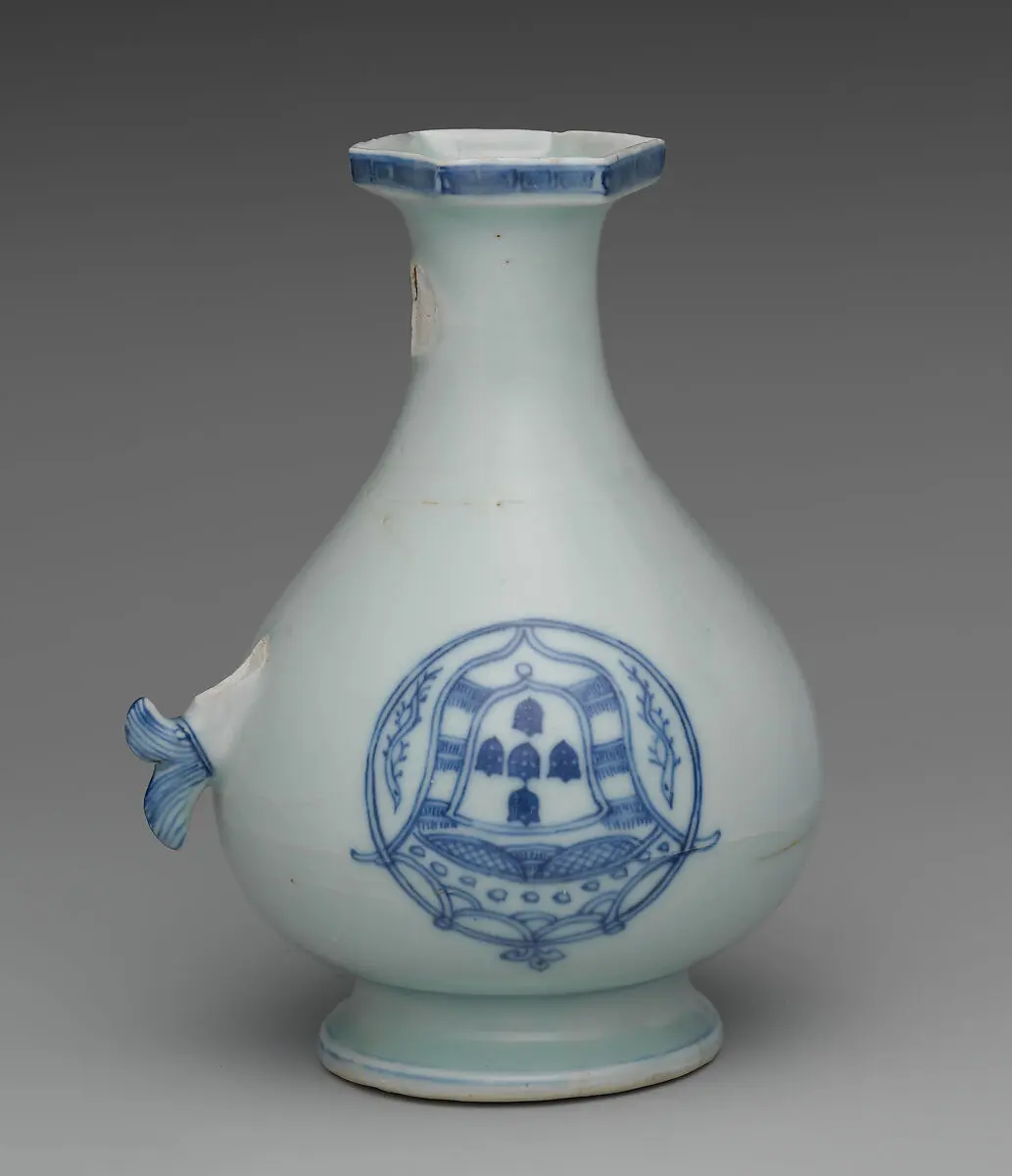
The museum dates the jug to about 1520–40 and identifies it as Jingdezhen ware. Its entry also gives the jug’s outline a history of its own. Chinese makers adapted a form derived from an Islamic metal vessel intended for a Near Eastern market. Trace the silhouette from foot to lip, then come back to the shield. The first detail links a Chinese potter’s work to metalwork made for another market. The second shows how that form took on a Portuguese identity.
Who ordered it? The catalogue identifies Portugal as the intended market and leaves the individual buyer unnamed. The shield answers a narrower question about this piece of Chinese porcelain. It tells us whose arms the painters were asked to represent. On the Okeover plate, the shield and the surviving paperwork together take us further.
Two families on the Okeover plate
Leake Okeover of England had a porcelain service made for him around 1740. The Met dates its nine-inch (22.9 cm) plate from that service to 1739–43. The decoration extends almost to the edge. Flowers run around the rim, scrolls spread out from the middle, and the shield sits low enough in the well of the plate to be framed by both. The Met, Plate, 1978.196
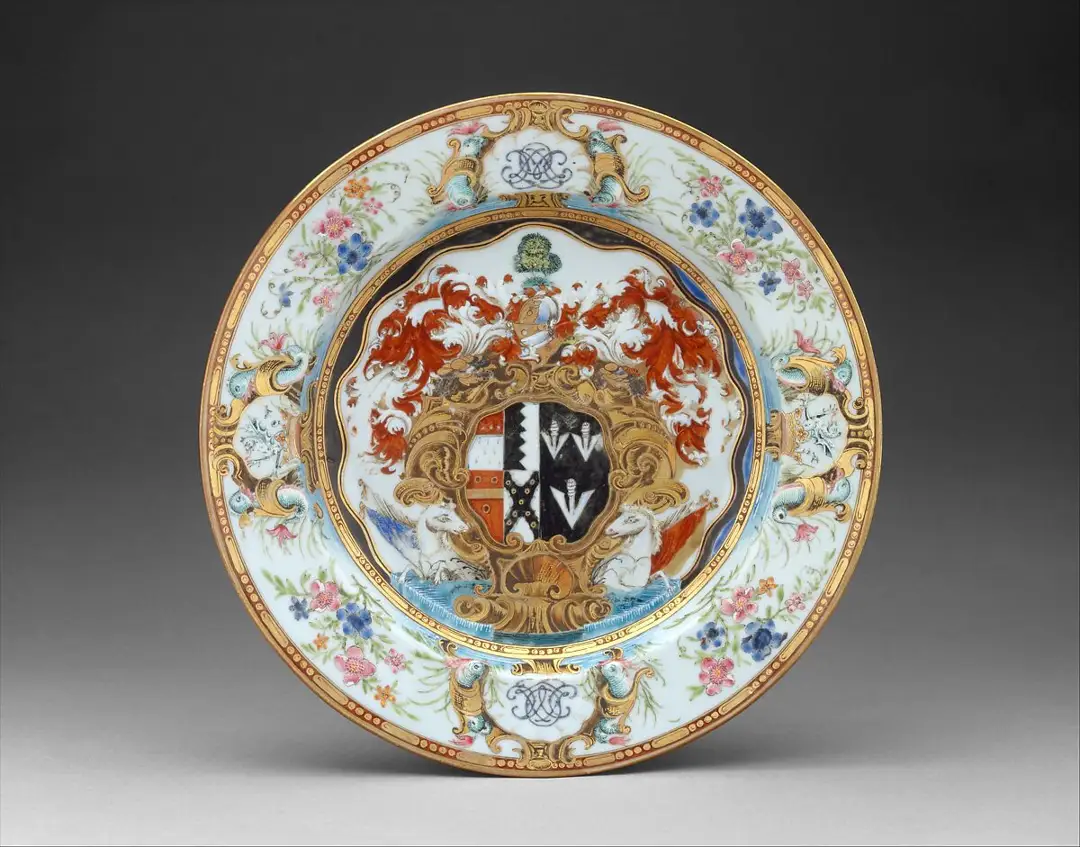
Look down the middle of the shield. It carries the arms of Leake Okeover alongside those of his wife, Mary Nichol. The heraldic term for joining two coats of arms in this way is impalement. Once you know both surnames, the division becomes legible as a marriage. There is a second way to read the couple’s identity. Among the flowers on the rim, small ornamental frames enclose the intertwined letters L, M and O, the joint monogram of Leake and Mary Okeover. A guest who knew their initials could have recognized the household without being able to decipher the shield.
What changed between paper and porcelain?
The back of the surviving drawing bears the words “Pattern for China.” One detail in the Met’s 2003 account makes that sheet especially revealing. The artist had painted white flowers on buff paper. The sheet itself supplied a warm background, so the pale petals showed up. On a white porcelain plate the same flowers would have been difficult to see. The flowers on the finished porcelain were given color.
Imagine setting a white petal cut from paper on a brown envelope, then moving it to a white saucer. The petal stays the same, yet its edge almost disappears. That is the small practical problem behind the change on the Okeover plate. The shield and the initials still identify the couple. The flowers explain something else about the people who made the service. They had to decide how a design supplied on one surface would read on another.
The museum’s bulletin records two shipments of the service from Canton, in 1740 and 1743. The invoices it describes list plates and dishes. Those details establish how the order was delivered, although they leave open which shipment carried the Met’s plate. The most revealing evidence of the work itself is still there at the edge. After reading the couple’s names in the shield, follow the rim past their initials to the flowers. Their color preserves a decision that an English drawing left to the painters in China.