The China Dish journal / A closer look
Huishan Opera Figurines: Pose, Robes and Painted Faces
Huishan opera figurines turn theatrical characters into small clay scenes through a combination of pose, costume and painted expression. A lifted sleeve carries a gesture beyond the hand; a turn of the head directs it toward another character. The face supplies the mood. These hand-modeled scenes belong to the clay-figure tradition of Wuxi, in eastern […]
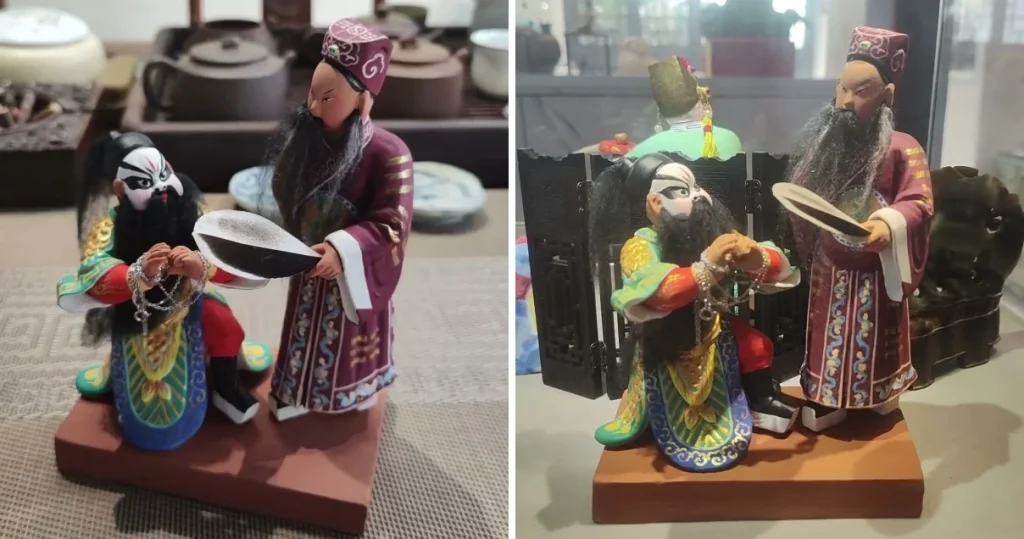
Huishan opera figurines turn theatrical characters into small clay scenes through a combination of pose, costume and painted expression. A lifted sleeve carries a gesture beyond the hand; a turn of the head directs it toward another character. The face supplies the mood.
These hand-modeled scenes belong to the clay-figure tradition of Wuxi, in eastern China. Their local name is shounie xiwen (手捏戏文). Following the body, robes and painted face leads into the work of painter Wang Nanxian, then a three-person encounter from the Legend of the White Snake.
Opera gestures become clay poses
A Huishan opera figure holds a selected moment from a performance. The maker has to give that moment a shape that remains readable after the actor’s voice and movement have stopped. A hand raised beside the face, for example, becomes part of a lasting relationship between the arm, head and body.
Traditional makers could shape the head, body and limbs separately, then join them. The parts allowed adjustments to the pose. Wang Jiaju’s essay on theatrical clay figures explains that Huishan makers selected and interpreted their subjects, giving particular emphasis to the characters and actions they wanted to express instead of copying the stage in every detail.
The pair below draws my attention to two different directions. The right-hand figure turns its face toward its companion while lifting an arm between them. The other face looks outward. The space around the raised hand makes that difference easy to see, even among the tall headdresses and long red tassels.
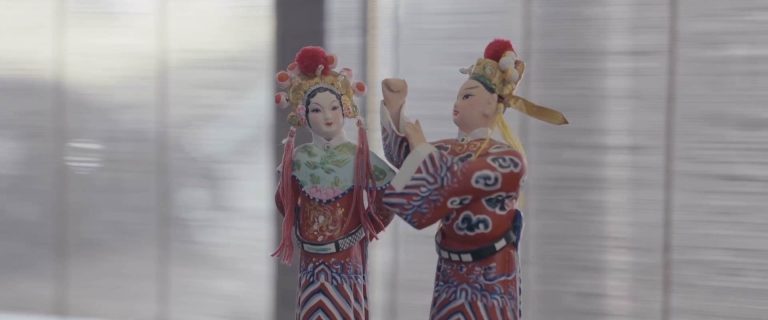
I can’t name this scene from its clothing alone. What I can follow is the gesture: the turned face and lifted arm belong to the same figure, but they lead my eye toward another. A title would give that visible encounter its dramatic setting.
The Huishan clay-figure overview places theatrical subjects alongside the tradition’s other reading topics. Within an opera scene, the body provides a starting point; the clothing makes its movements larger.
Robes give Huishan opera figures movement and support
The sleeves and robe edges of Huishan opera figures carry part of the action. Onstage, an actor can lift a robe or sweep a sleeve to express emotion. In clay, the sweep has to remain in place. Clothing gives the sculptor a broad surface on which to extend the movement of an arm or torso.
Yu Xianglian, a sculptor who worked with Wang Nanxian, found a practical use for that theatrical clothing. In the National Art Museum of China’s study, she lengthens the lower robe edge and makes the part near the ground slightly thicker, allowing the costume itself to help support the figure. The treatment helped the figure bear weight while preserving the expressive line of the costume.
I like the double task of that hem. Its outline belongs to the performance, and its weight belongs to a small object that has to stand. A detail that looks decorative can also answer a problem in construction.
The photograph above shows the upper bodies, where the sleeve curves around the raised arm. A full view down to the feet would let us follow the robe’s other job. For a finished figure, looking from shoulder to hem can connect a grand gesture with the quieter shape that supports it.
Wang Nanxian paints character into a small face
The painted face brings the broad movement of a Huishan opera figure down to a few fine marks. Wang Nanxian’s work makes that change of scale especially clear. Her specialty is painting; Yu Xianglian’s is modeling. Their contributions meet in a face whose clay shape and painted features have to work together.
Wang holds a small head close to her brush in the photograph below. Her left hand supports it while her right hand holds the slender brush almost upright. I notice how little room the face gives her. A change around an eye can occupy a tiny area yet affect the expression of the whole head.
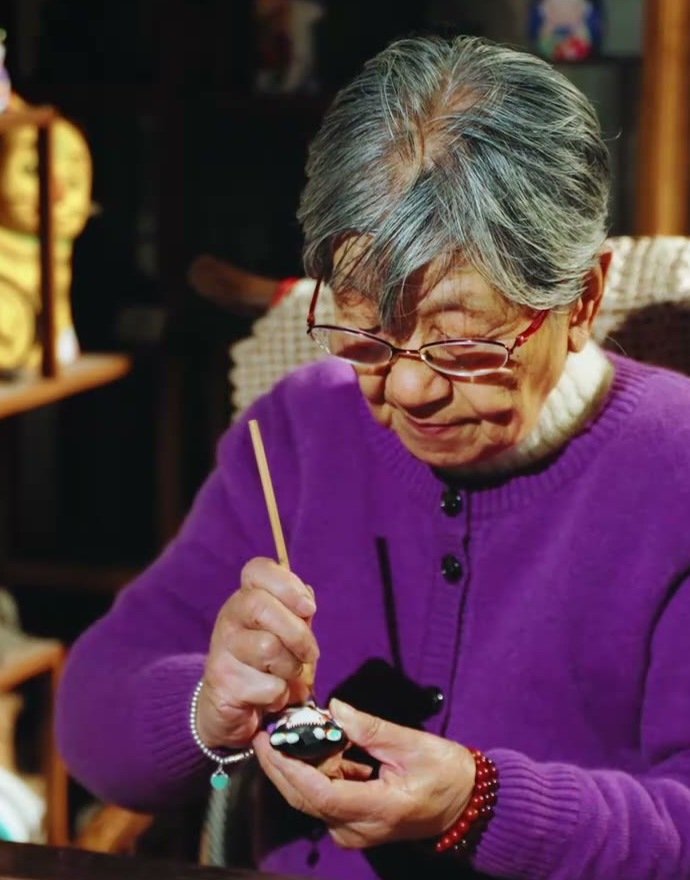
Painting the facial features is called kaixiang (开相), a stage that gives particular attention to expression and character. Eyebrows, eyes and the mouth help distinguish age, temperament and feeling. The National Art Museum’s account describes a range of ways to paint the brows and eyes, chosen to suit different figures.
Wang also uses a brush-loading method known as banbitou, or half-tip painting. A 2017 Guangming Daily profile describes loading color onto only half the brush tip. The museum’s fuller account explains ways of combining water and color on the brush to create soft transitions. Those changes in color help give a face warmth and a sense of stage makeup.
The brush in her hand doesn’t reveal its entire loading method, but the small head makes the scale of her task tangible. I find that a useful reason to look at the face slowly. The first impression may be a smile or a stern gaze; closer attention finds the separate marks that bring it about.
Broken Bridge: three opera figures in conflict
The connection between gesture and expression comes into focus in Broken Bridge, a Huishan scene from the Legend of the White Snake. The National Art Museum of China holds Yu Xianglian and Wang Nanxian’s version from 1985. Its three characters share one tense encounter: Green Snake, White Snake and Xu Xian, White Snake’s husband.
Green Snake draws her sword against Xu Xian because of his betrayal. White Snake tries to stop her, still moved by her feelings for her husband. Xu Xian has fallen to the ground in fear and remorse. The museum identifies these opposing actions as the conflict concentrated in the sculpture.
The three figures give us more than three separate moods. One threatens, another restrains, and the third suffers the force of their disagreement. The actions depend on one another. Knowing the whole opera would add context, but this selected moment already has a clear dramatic problem.
For me, the useful question is where an action goes. A hand might point into empty space in an isolated portrait; within a group, its direction can reach a companion or interrupt another gesture. A face then helps us read the feeling attached to that movement. The little clay stage holds those relationships still long enough to examine them.