The China Dish journal / A closer look
Huishan Figurines: Regional Tradition and Wang Nanxian
Huishan figurines belong to a local clay-art tradition in Wuxi, Jiangsu, in eastern China. Wang Nanxian’s learning gives that tradition a human shape: an interest nurtured in her family’s shop became formal training, study with painters and a long partnership with a sculptor. Her route connects the town’s workshops with the skills carried into its […]
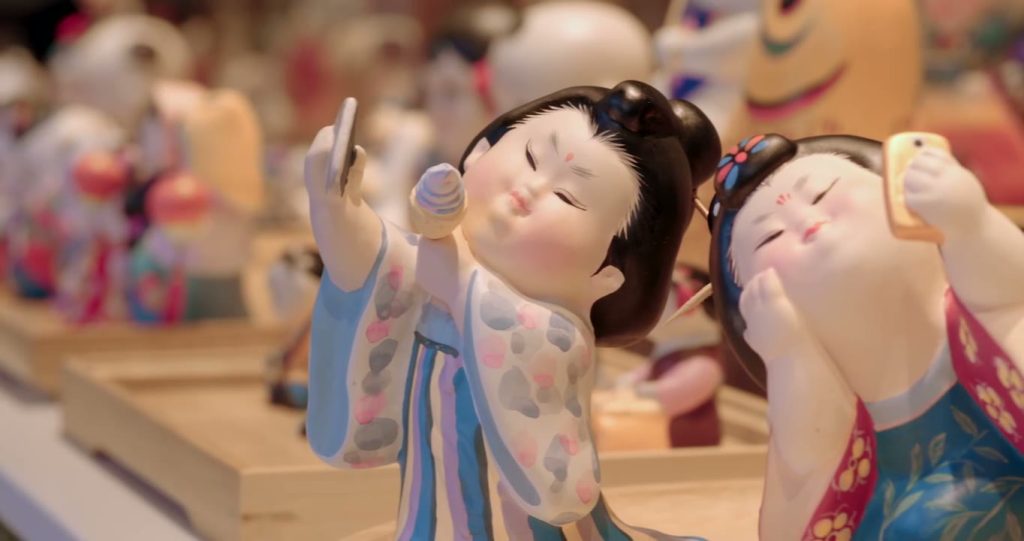
Huishan figurines belong to a local clay-art tradition in Wuxi, Jiangsu, in eastern China. Wang Nanxian’s learning gives that tradition a human shape: an interest nurtured in her family’s shop became formal training, study with painters and a long partnership with a sculptor. Her route connects the town’s workshops with the skills carried into its painted figures.
The story follows Wang from the training school to teachers and older works, then to collaboration and the figures gathered for display.
From Huishan workshops to Wang Nanxian’s training school
Huishan’s workshops developed from making figures during quieter farming seasons. Local residents turned a sideline into specialized work, giving the craft places where objects could be made and sold. The mountain’s name became attached to the figures, but the tradition also depended on people working around it.
That local work acquired a new organization in the twentieth century, with a cooperative established in 1954 and the Huishan clay figurine factory following in 1958, according to a Xinhua account published on Wuxi’s government website. Those dates describe the organization of production; Wang’s own schooling belongs within the same period.
Wang entered a clay-sculpture and painting training class in 1956. Her family ran a tea house and an arts-and-crafts shop, and the figures popular with its customers caught her interest. Lin Qi’s 2019 China Daily profile connects her decision to study with that early attraction to the objects.
I like the shop as a starting point. A figure there was something someone wanted to take home. The training class offered a different relationship with it: learning to make the shape and color that had first attracted attention. Interest could become a skill practiced alongside other learners.
The Huishan reading guide places this local tradition beside the site’s topics on clay, figure types and theatrical subjects. Here, the thread is the person learning within that setting.
Wang Nanxian learns color from teachers and older figures
Wang’s training brought together drawing, sculpture, color and sketching from life with art theory and basic opera knowledge, giving her more than a stock of patterns to repeat, as her national intangible-heritage biography makes clear. Yu Renjin was her first teacher. At the Huishan factory, she later studied painting techniques with Chen Yuxiu.
Those subjects connect different kinds of attention. Drawing asks how a line describes a form; color asks how one area relates to its neighbors. A painter working on a small modeled face has both questions in front of her. I find the breadth of Wang’s schooling helpful for understanding why painting a figure involves more than filling spaces.
Wang sits among figures, brushes and containers at her worktable below. She holds a small figure in one hand and a brush in the other. Finished colored figures occupy the shelves behind her, while several darker forms stand closer to the table. Making and looking have room in the same workspace.
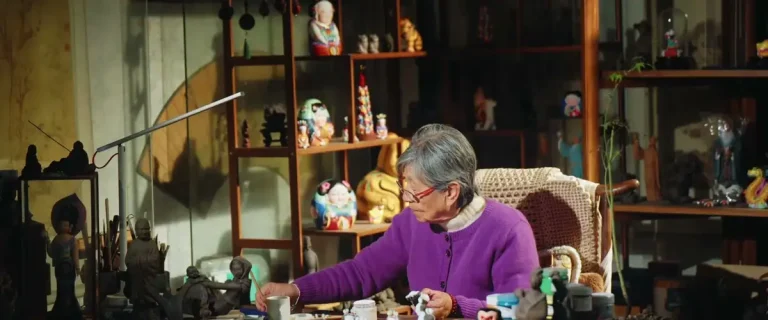
Older works became another source of study. The national biography records three visits to Nanjing Museum during the 1980s to copy Qing-dynasty figures. Copying here was part of her learning: a finished work could be examined closely and reconstructed through her own practice. The teacher and the earlier object offered different ways to carry knowledge forward.
Wang Nanxian’s painting partnership with Yu Xianglian
Wang’s strength in color also found a place in shared work. She and Yu Xianglian met through the training school, where Yu showed a gift for modeling and Wang for painting. Their collaboration continued for about four decades, according to the 2019 China Daily profile.
A partnership makes the finished figure harder to divide into separate achievements. The modeled surface gives the painter cheeks, a mouth and clothing to work with. Painted marks then direct attention across those forms. The two contributions meet on the same small body, where a face’s expression depends on how shape and color work together.
I think that shared surface gives “tradition” a useful scale. One maker’s knowledge can meet another’s in an object small enough to hold. The partnership preserves a relationship between skills as well as a set of familiar designs. Wang’s part in the work remains distinct, even when the result belongs to both makers.
Huishan figures on display: a place to keep learning
Finished Huishan figures can continue that exchange through display. In the room below, broad smiling figures occupy the front tables, while smaller, differently shaped figures stand along the side shelves. The arrangement gives the eye room to compare a prominent silhouette with details that require a closer look.
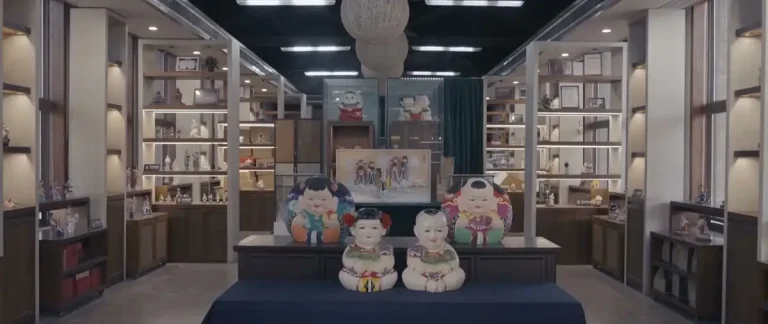
The display holds several possible starting points for learning. A large face is easy to notice from across the room; a small figure asks for a slower approach. I would begin with whichever catches my eye, then look for what the neighboring works do differently. Comparison makes a roomful of figures easier to enter.
Wang’s visits to study older museum works give that looking a practical history. Finished figures could teach someone who already knew the craft and wanted to understand it further. The shelf and the worktable belong to different moments in learning: one holds the completed work, while the other allows its lessons to become another painted figure.