The China Dish journal / A closer look
Looking closely at Da Afu
Da Afu is a rounded child figure from Huishan in Wuxi, eastern China, associated with good fortune and protection. The large head, seated body and animal held close to the chest give a gentle face an unexpectedly powerful role. Its decorations and local legends explain that combination. A closer look begins with the face, moves […]
Da Afu is a rounded child figure from Huishan in Wuxi, eastern China, associated with good fortune and protection. The large head, seated body and animal held close to the chest give a gentle face an unexpectedly powerful role. Its decorations and local legends explain that combination.
A closer look begins with the face, moves to the animal and clothing, then follows the stories behind them. The details vary between figures, so an individual example is worth more attention than a single label.
Da Afu’s round face and gathered silhouette
Da Afu’s head and body gather into a compact shape. A Wuxi local-history account describes the figure’s rounded surfaces and simplified outline, with small projecting details absorbed into the whole. That’s a useful starting point for looking: the child has a strong presence before any flower or painted curl comes into focus.
The figure below brings the smile forward. Broad cheeks surround a small nose, the eyes narrow at the corners, and a red mouth curves around a white smile. Two hands hold the green animal across the chest, while the red shape behind the face gives the composition another rounded edge.
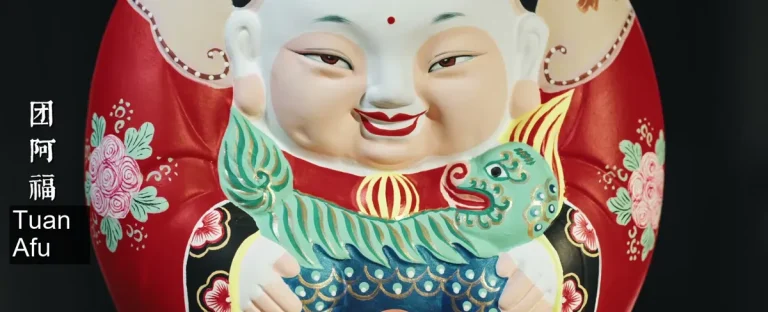
I find the hands especially helpful here. They draw the child’s face and the animal into one close embrace; the animal’s raised tail and open mouth add movement inside that rounded outline. The smile remains the first thing I notice, even with so much painted decoration around it.
Da Afu can appear as one child or a pair. The local stories also include both a single child and twins, so calling every figure a boy would flatten those differences. The image and its object description provide a better place to begin than guessing from the painted face.
The Huishan clay figures guide places Da Afu among the site’s topics on local clay, traditional figure types and opera subjects.
What does Da Afu hold, and what does it mean?
Da Afu commonly embraces a lion-like beast associated with protection, though the held object varies. Wuxi’s local-history accounts describe a green lion, a lion-faced beast and, in one passage, a creature combining lion and tiger features. An English China Today account also describes figures holding a fish or a qilin, a mythical auspicious animal.
The green animal in the close view has a curling tail, patterned body and open mouth. I wouldn’t settle its species from those details alone. A figure with a documented object description gives a firmer answer, as the Qing-dynasty example below does.
Wuxi Museum identifies this Da Afu’s animal as a green-maned lion and explains its protective meaning. The child’s arms stay close to the body, and the beast stretches across the front almost like a raised panel. The flower ornaments, chest pendant and footwear carry additional wishes in the museum’s reading of this particular work.
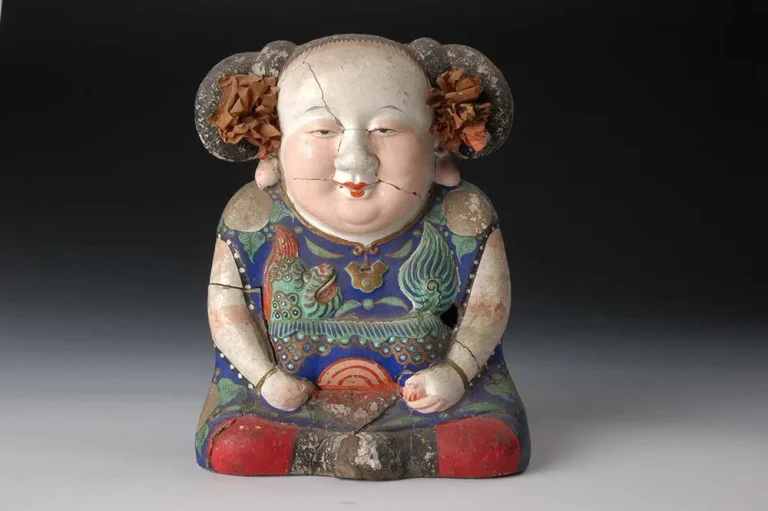
| Detail on the museum’s Da Afu | Traditional wish in the museum’s description |
|---|---|
| Peony ornaments at the head | Wealth and prosperity |
| Clothing associated with five blessings | Receiving good fortune |
| A longevity-lock pendant at the chest | Long life |
| The green-maned lion | Warding off evil |
| Red-soled boots | Success in the imperial examinations |
The last detail connects a child with hopes for later achievement. Imperial examinations were the historical route into official service; the boots give that wish a visible place on the figure. These meanings belong to the museum’s account of the object, rather than a rule that every red or white patch on every Da Afu has the same symbolism.
The Wuxi Museum object discussion brings those details together. China’s national intangible-heritage description places Da Afu among folk figures expressing wishes for blessings, safety and enough food and clothing. The small smiling child can carry quite a large set of household hopes.
Da Afu legends: twins, Shahai’er and Nian
Da Afu’s protective beast has several local stories behind it. Wuxi’s published accounts preserve different characters and events, so each version deserves its own telling. They’re legends explaining a beloved image, not a dated record of how a named maker invented it.
The twins and the lion-faced beasts. A 2013 account on Wuxi’s local-history website tells of a boy and a girl, twins known as Da Afu, who were plump and always smiling. They subdued two lion-faced beasts that had been harming villagers. People honored the children with clay images, giving the pair a place in wishes for peace and protection.
Shahai’er and the lost wooden wedge. The Wuxi archives’ 2012 “Legend of Afu” gives a longer, sadder story. Shahai’er, a child who ate dangerous beasts, made the mountain safe for woodcutters. His glance and smile left the animals unable to move. One night, curiosity brought him to a tree the woodcutters had partly sawn through.
A wedge held the cut open. Shahai’er dislodged it while looking inside, and the closing tree killed him. The woodcutters buried the child, but the beasts became dangerous again. Villagers then made clay likenesses with a beast in their arms; in the story, those images restored protection. The held animal combined qualities of a lion and a tiger.
Afu and Nian. Another version in the 2013 account concerns Nian, a monster that swallowed the sun by day and the moon by night, disturbing people’s lives. Afu conquered it and held it obediently in his hands. Peace returned. That account ties the embrace to a wish for an orderly, safe life.
The twins’ victory, Shahai’er’s death and Nian’s capture each explain protection differently. I like leaving those differences visible: the gentle smile gains something from the stories’ danger. An animal held so comfortably can suggest a threat brought under control, giving the rounded child a strength that’s easy to miss at first glance.