The China Dish journal / A closer look
Crazing in Pottery: Why Glaze Cracks and Crackle Forms
See how crazing develops in a fired glaze, what two studio cup tests reveal about delayed cracks, and why a Guan ware bowl was prized for its crackle.
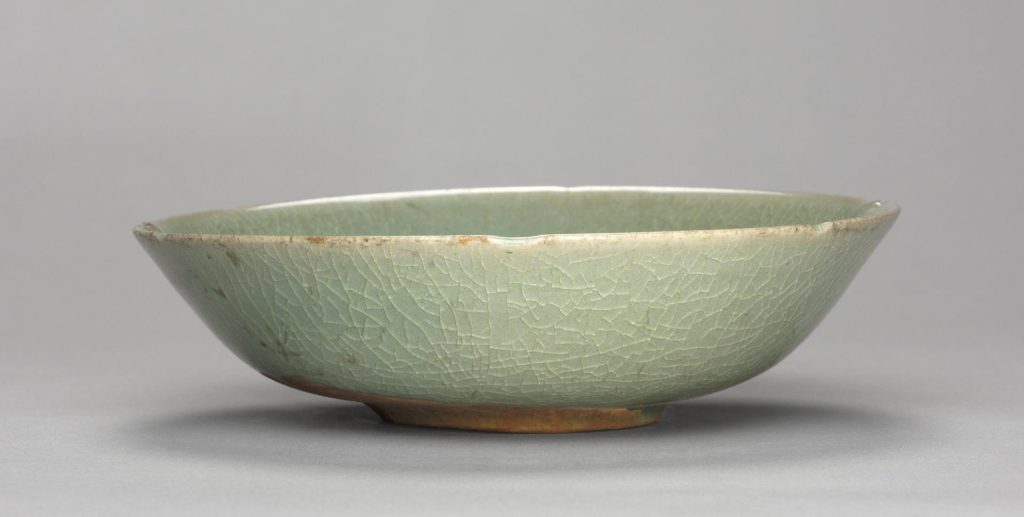
Crazing in pottery is a network of fine cracks in the fired glaze. It usually develops when the glaze tries to shrink more than the clay beneath it as the pot cools. The cracks can appear in the kiln or become visible later. When a potter chooses a glaze for the pattern those cracks will make, the effect is called crackle.
What crazing looks like up close
Start near the middle of Lara604’s photograph and follow one of the longer gray lines. Shorter cracks meet it from either side. Together they enclose small, uneven patches of pale glaze. Some are nearly rectangular, and others have curved sides. Even where the lines are faint, you can follow one patch into the next.
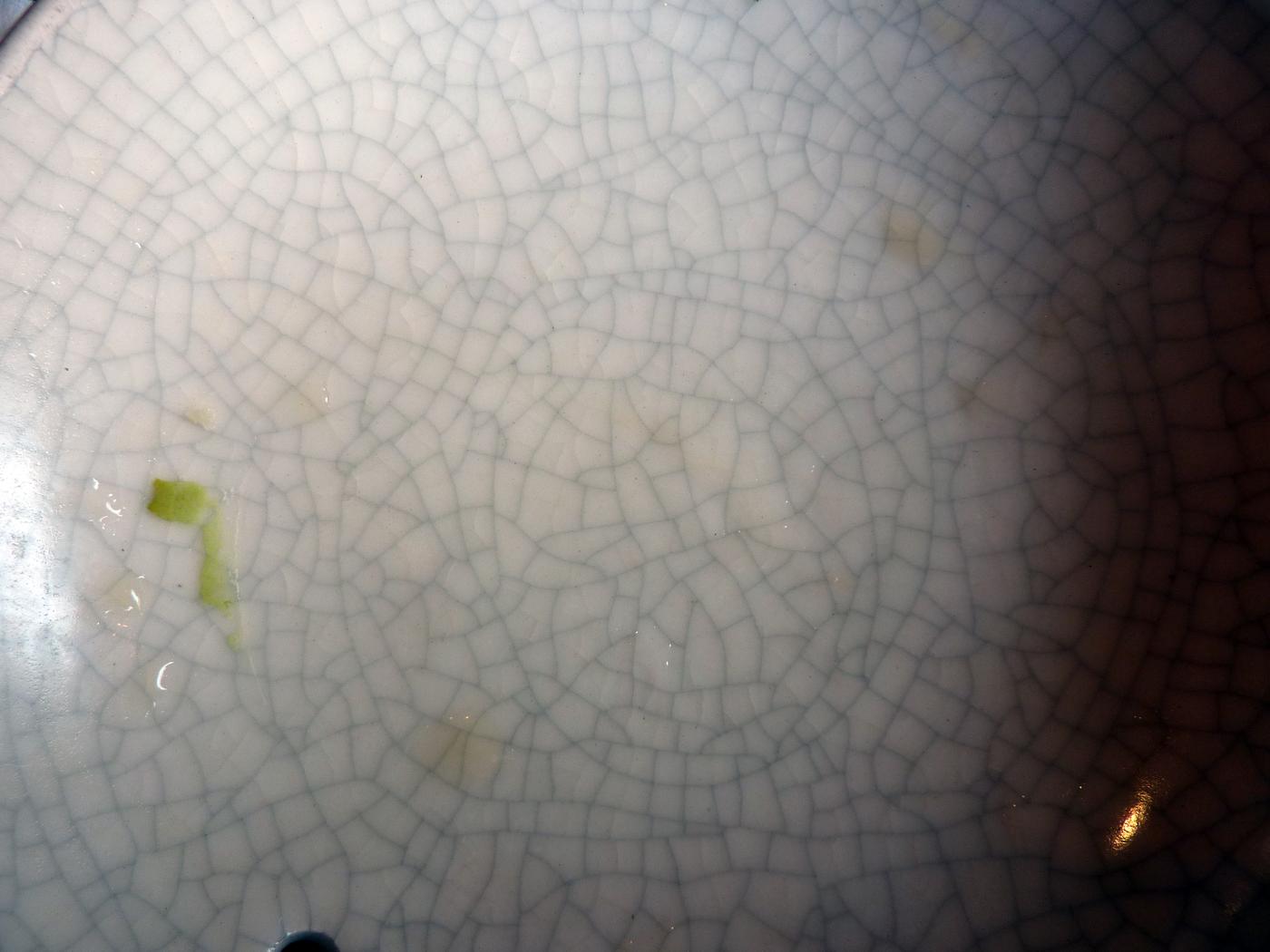
Photograph by Lara604, shown in full. Original photograph and CC BY-SA 2.0 license

The photograph gives a good view of the surface. How deep a particular crack runs is a different question. A line that continues across an exposed clay edge gives you reason to examine the body as well as the coating. Here the view is all glaze. Its pattern alone can’t establish the clay recipe, when the lines opened, or whether the piece is suitable for food use.
Why a glaze cracks as the pot cools
Imagine the thin coating on a porcelain mug and the much thicker wall beneath it. In the kiln, the glaze melts against the clay. As the mug cools, the glaze becomes rigid while both materials still have some shrinking to do. If the glaze would contract more on its own, the wall holds it slightly stretched. A crack releases some of that tension. Across a mug, many such cracks can form a web. Porcelain and its fired body
Potters call the relationship between the two materials glaze fit. A slight squeeze from the cooling clay can help keep the glaze intact. Too much pressure in that direction brings a different fault: little flakes of glaze can break away, especially along an edge. Potters call this shivering. Fit depends on which body and glaze were fired together.
Two test cups that looked sound out of the kiln
Digitalfire tried several thicknesses of a silky matte glaze called V.C. 71 on the side of a white porcelain mug. After the cone 6 firing, the surface showed no visible crazing. The change came during a later studio test that subjected the mug to sudden cooling. The tester then marked the surface with a felt-tip pen and wiped away the excess ink so that the fine lines would show up in the photograph.
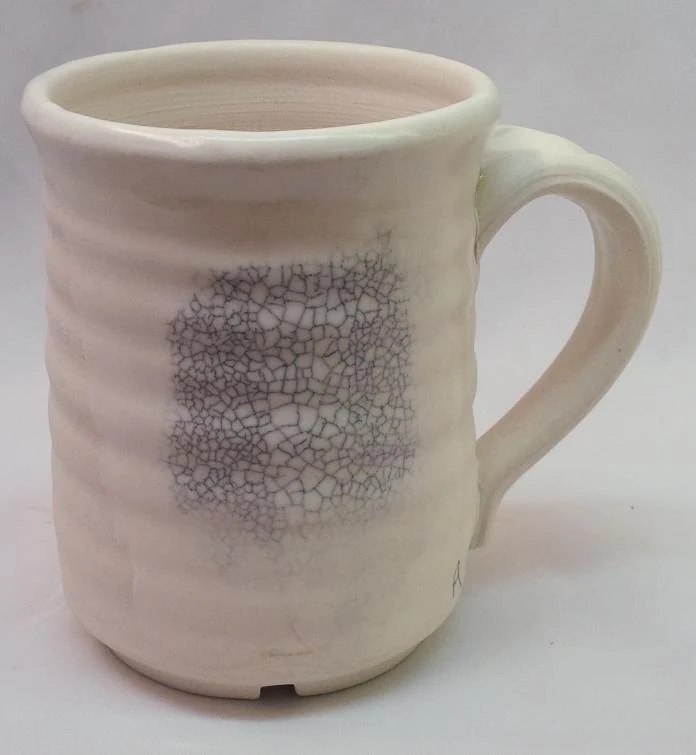
Look at the pale spaces within the dark patch. The ink makes it possible to distinguish individual cracks even where several meet. At the edge of the patch the lines become hard to follow. That fading edge tells us where the cracks are easiest to see in the photograph. It gives us no reliable boundary for the crazing itself.
Digitalfire coated the second cup, made from Plainsman Buffstone clay, with a version of its G1916Q clear glaze that contained Frit 3110. This was a lower firing, cone 04. The tester described the glaze as clear when the cup left the kiln. After the thermal test, a network with larger, more widely spaced lines showed through the water. The record also describes water entering the porous clay beneath the cracked glaze.
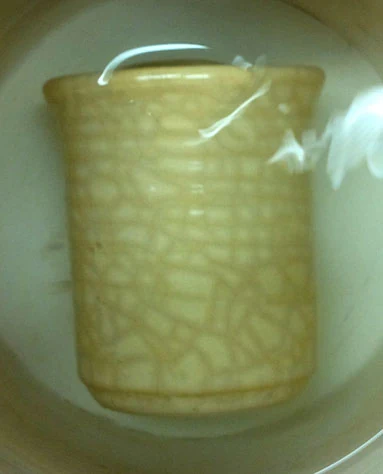
Each photograph shows a different cup after testing. The earlier appearance of each comes from the tester’s notes. That distinction matters if you’re looking at a cup with newly noticed lines. A photograph taken today can show their spacing and extent. An earlier close view or the maker’s firing notes would help establish when they first became visible. Knowing the kind of clay narrows the question, though broad categories still cover many different glaze and body combinations. Earthenware, stoneware and porcelain compared
When the potter wants the crackle
A shallow Guan ware bowl at the Smithsonian’s National Museum of Asian Art offers a documented example. Made in Hangzhou in the 12th or 13th century, it has a grayish-blue glaze crossed by brown lines. The museum identifies the crackle as the bowl’s only ornament. Without a painted flower or carved border to draw the eye, the spacing of those lines gives the eye a path across the bowl.
Intentional crackle comes from the same tension that opened the glaze on the test cups. A potter can also rub color into the cracks to bring out the drawing they make. Dark lines alone tell us little about that choice. On the white test mug, the tester applied ink to make a fault visible. On the Guan bowl, the museum identifies the network itself as the decoration. To read an unfamiliar piece, begin with a line you can follow, then look for the maker’s or collection’s account of why it is there.