The China Dish journal / A closer look
Underglaze vs Overglaze on Chinese Porcelain
Compare underglaze and overglaze on Chinese porcelain through a Jingdezhen dish whose blue flowers were fired before its red background was painted.
Underglaze decoration goes onto the porcelain body before the potter covers it with glaze. Overglaze decoration goes onto the already fired glaze and returns to the kiln. A single dish can carry both. On an eighteenth-century dish from Jingdezhen, the blue leaves came first. The broad red background that seems to sit behind them was painted later.
Where the paint goes and when the piece is fired
Picture a painter drawing a blue leaf on a pale dish. For underglaze painting, the painter works directly on the porcelain body. A potter covers the drawing with transparent glaze and fires the dish. The blue leaf remains visible through that glaze, just as the pale body shows through wherever the painter left a gap.
For overglaze decoration, the painter picks up a dish that has already been glazed and fired. Enamel goes directly onto that surface. Another firing, usually at a lower temperature, fuses the enamel to the glaze. On a piece that combines the two methods, the painter can follow the edge of a blue leaf that is already there.
| Underglaze painting | Overglaze enamel painting | |
|---|---|---|
| Surface the painter starts with | Ceramic body | Fired glaze |
| Next kiln stage | Fire the glaze covering the drawing | Fire the added enamel onto the glaze |
| Example on the Jingdezhen flower dish | Blue leaves and flowers | Red ground around them |
Blue leaves on a red ground
In the Met’s photograph of Dish with flower scrolls, follow the thin white circle around the flowers. Outside it, the red spreads nearly to the rim. Inside it, the same red shows through the gaps between the blue leaves. Seen from above, the dish looks much as it might if someone had started with a field of red and painted a blue spray across the middle.
The Metropolitan Museum of Art identifies the blue as underglaze cobalt and the red as overglaze enamel. That gives the design a different order. The blue flowers and leaves were already visible through the fired glaze when the red was added around them. Here the part you might call the background was one of the painter’s finishing touches.
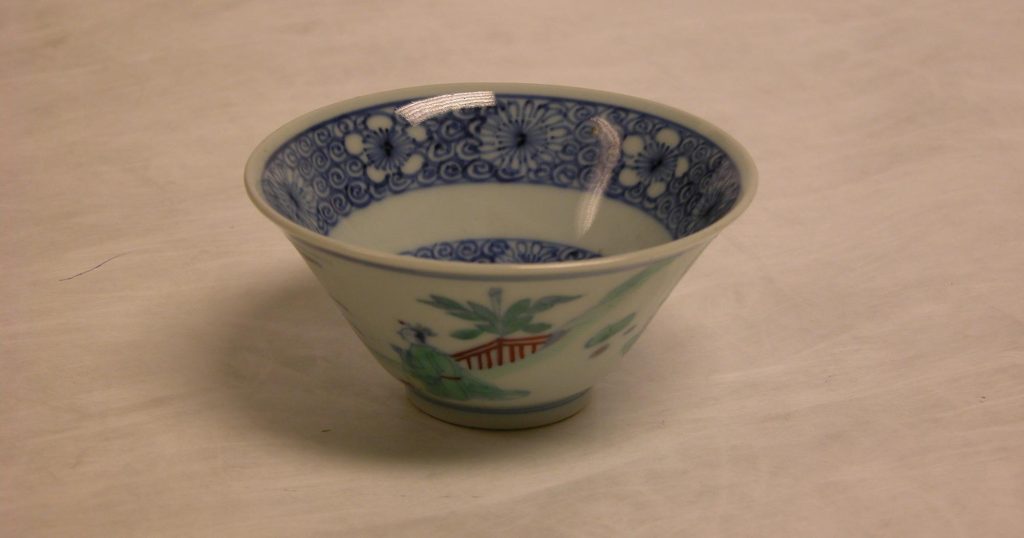
An earlier dish in the same collection shows how much variety that sequence allowed. Measuring just 6½ inches (16.5 cm) across, it depicts an immortal and bears the mark of the Tianqi reign of the Ming dynasty. The Met dates it to that reign, 1621–1627. Its record identifies underglaze blue and several colors of overglaze enamel. On the flower dish the museum names a single overglaze color, red. On the smaller Ming dish it uses polychrome, meaning several colors, without assigning every brushstroke in the scene to a particular layer.
One coat of arms in blue, another in enamel
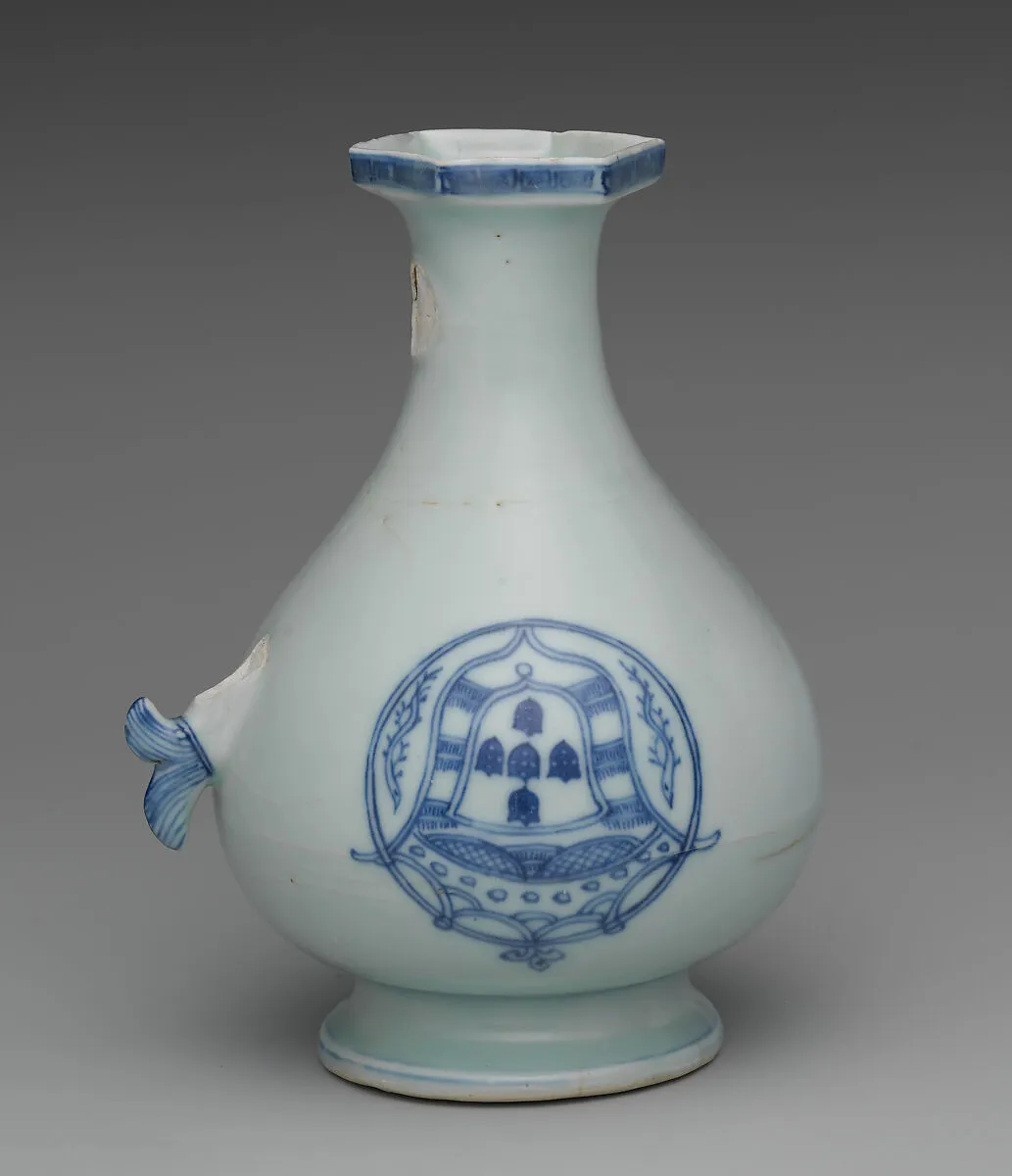
A Jingdezhen jug made around 1520–40 carries the Portuguese royal arms. Find the blue shield on the widest part of the jug, then look for the crown. It hangs below the shield. The Met points out that the painter turned the arms upside down. Even that small detail was already in place when the potter covered the cobalt drawing with transparent glaze and fired the jug.
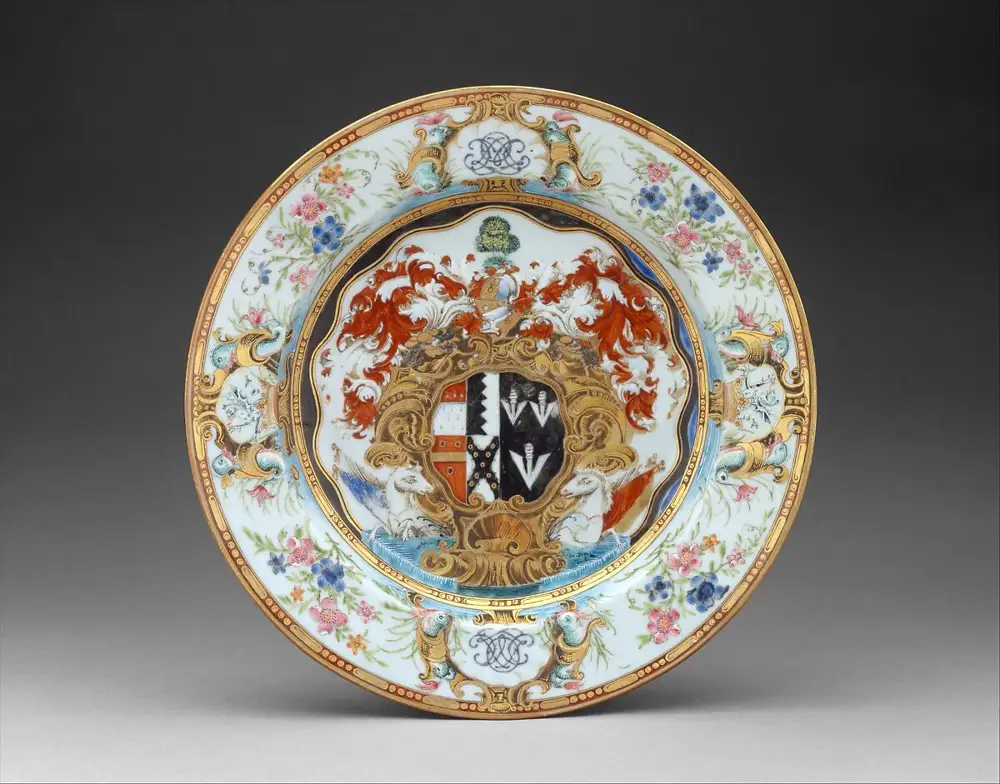
On a Chinese plate made for the British market in 1739–43, a shield again occupies the center of the design. This time red scrollwork curls around it, and small painted flowers are scattered across the rim. The Met identifies the plate’s enamel painting and links the popularity of multicolored overglaze decoration on export porcelain to the demand for coats of arms. Color gave painters another way to distinguish neighboring parts of a shield, a difficult job when every part had to be drawn in blue.
How to read a label for mixed decoration
Start with the material description. On the Portuguese jug, it places the cobalt beneath the glaze. On the British-market plate, the short material entry tells you only that the body is hard-paste porcelain. You have to read the curator’s note to find the enamel painting. Color alone can lead you astray. The Jingdezhen flower dish uses red over the glaze, but Chinese potters also produced red designs by painting with copper pigment beneath the glaze.
Occasionally a label gives a particular name to the way the two stages work together. On a fifteenth-century chicken cup in the British Museum, the decorators drew outlines in underglaze blue, glazed and fired the cup, then filled parts of the design with enamels and fired it again. The museum calls this technique doucai. The museum points to the rooster’s feathers, where fine strokes of red enamel give the plumage its texture.
The Met’s flower dish is worth a second look once you’ve read its label. Pick out the tip of a blue leaf in the museum’s photograph and trace its edge against the red. When that leaf first emerged from the kiln, the deep red beside it was still to come.