The China Dish guides
Overglaze: Enamels, Firing and Chinese Porcelain Color
Overglaze decoration adds color to the surface of an already glazed and fired ceramic, followed by another firing that fixes the decoration. On Chinese porcelain, the term often means painted enamels, from clear greens to opaque pinks.
Their materials, firing sequence, and place within a finished design explain how a white dish can become a lotus pond or a crowded courtyard.
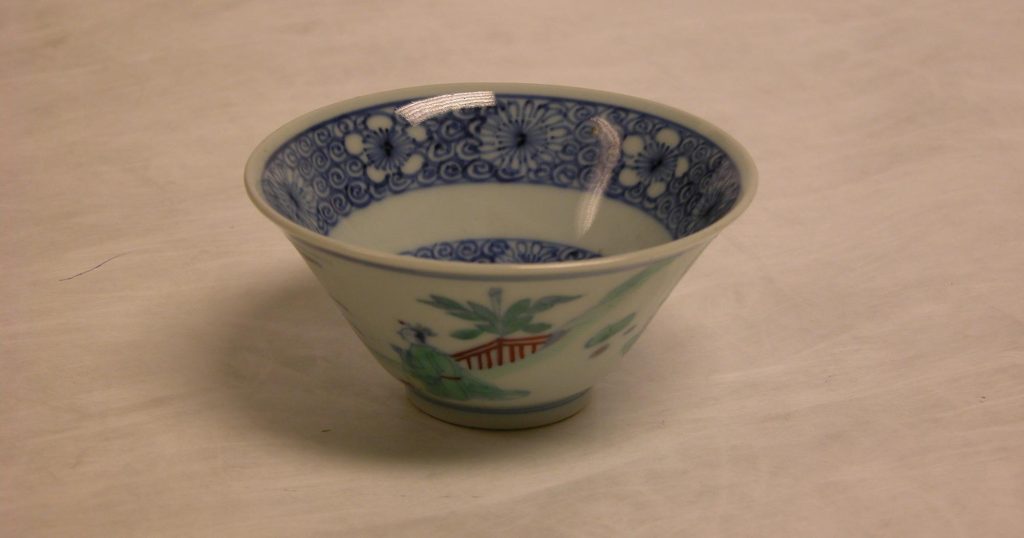
A few details to notice
Look a little closer.
Read the object account and sources ↘
Read the object account and sources ↘
01 / A closer look
What does overglaze add?
- Fired glaze
- Added color
- Further firing
Overglaze enamels add painted decoration to an already glazed and fired ceramic surface. The ceramic body and its glaze remain distinct layers.
What overglaze adds to a fired porcelain surface ↗
From the referenced guide section and its sources.
02 / A closer look
Why fire the piece again?
A later, lower-temperature firing fuses the added enamel decoration onto the existing glaze.
Why overglaze enamels need another firing ↗
From the referenced guide section and its sources.
03 / A closer look
Which surface treatment is it?
Painted enamel, metallic luster, overglaze decals and reglazing describe different treatments. The object record helps keep their names apart.
Overglaze enamels, metallic lusters and decals ↗
From the referenced guide section and its sources.
Making
From fired glaze to enamel decoration
The fired glaze is the starting surface. Enamel painting adds the colors, and another firing fixes that decoration.
- 01Glaze firing
Establish the fired glaze surface
- 02Enamel painting
Apply the low-melting colors
- 03Further firing
Fuse the added decoration
01 / The guide
What overglaze adds to a fired porcelain surface
Porcelain’s body, glaze, and painted decoration do different jobs. The body supplies the vessel’s shape. The glaze forms its glassy covering, and overglaze enamels add a design onto that fired covering. A flower painted in enamel therefore belongs to a later stage than the white glazed surface beneath it.
The Museum of Oriental Ceramics, Osaka, describes low-melting pigments applied to this already fired surface and then fired again. Its account includes multicolored decoration, added gold, and combinations with painting beneath the glaze.
A single bowl can bring several decorative decisions together while keeping one continuous design.
Ceramic terminology also depends on context. Tony Hansen’s Digitalfire glossary includes painting over an unfired glaze within the broader use of “overglaze.” Here, we’re looking at separately fired enamel decoration on Chinese porcelain. A studio instruction sheet may mean something broader.
The word describes a relationship to the glaze, rather than the clay recipe. For the clay body beneath these colors, turn to our porcelain guide.
02 / The guide
Why overglaze enamels need another firing
The later firing allows the enamel to fuse onto a surface that is already glazed. A low-melting glassy component carries the color, so the decoration can mature below the temperature used for the main glaze. The high-fired porcelain and the later enamel layer have different firing requirements.
Think of the sequence as a finished glazed vessel receiving its painted design. The outline below follows Osaka’s explanation of enameling; it describes the relationship between stages, rather than a kiln program for making a particular piece.
| Stage | What happens to the surface |
|---|---|
| Glaze firing | The vessel acquires its fired glaze surface |
| Enamel painting | The decorator applies low-melting colors to that surface |
| Further firing | The added decoration fuses in a lower-temperature firing |
The British Museum’s account of Chinese porcelain makes the lower-temperature refiring explicit. In combined decoration, part of the design has already passed through the glaze firing before the decorator adds the remaining colors. Each area has its own stage. We can’t read the whole design as one firing.
Calling this a “third firing” can be useful in a production sequence that includes an earlier biscuit firing, but the important point for reading an object is the extra firing after glazing. The full route from forming clay to firing a vessel belongs to how porcelain is made.
03 / The guide
Overglaze enamels, metallic lusters and decals
The decoration added after glazing can take several forms. Painted enamels supply colored lines and areas; metallic lusters give metallic or iridescent effects. A decal describes a way of transferring a design, so it answers a different question from the name of the coloring material.
Hansen describes ceramic lusters as liquid preparations involving precious metals, applied to fired ceramic surfaces. Such a coating may produce the gold or shifting sheen familiar from modern studio decoration.
That effect differs from a painted leaf or pink garment, even though both can belong to the broad family of decoration added over a glaze.
An overglaze decal places a prepared design onto the glazed surface for firing. The word “decal” identifies the transfer method; “overglaze” identifies its relation to the glaze. Repetition doesn’t prove transfer printing. A painter can repeat a design too.
| Term | What it helps identify |
|---|---|
| Painted enamel | The fired colored decoration |
| Metallic luster | A metallic or iridescent surface effect |
| Overglaze decal | A transferred design applied over the glaze |
| Reglazing | Applying another glaze layer |
Reglazing and overglaze decoration can both involve further work on a fired piece, but the operations have different aims. When a description says that a plate has overglaze enamels, it is identifying its decoration. It doesn’t mean that the potter simply covered the plate in another full layer of glaze.
04 / The guide
Chinese overglaze palettes: wucai and famille rose
Chinese ceramic names may describe a group of colors, a painting technique, or a later way of classifying objects. Two useful names are wucai and famille rose. They help organize the visible colors, while a material description explains how those colors were applied.
Wucai painting and overglaze blue
Multicolored enameling is known in Chinese as wucai (五彩), commonly translated as “five colors.” Osaka’s guide gives red, yellow, green, and purple among its colors. I don’t count five patches on every vessel.
Blue also needs its own evidence. The Met’s early eighteenth-century Platter with the Story of Pan An is cataloged as porcelain painted in overglaze polychrome enamels.
Its description specifically notes overglaze blue among the developments of the Kangxi period, a useful reminder that a blue area needn’t automatically mean painting beneath the glaze.
On that platter, the roofs, foliage, costumes, and small figures divide the scene into many colored parts. My eye follows the blue roof lines across the upper buildings before moving into the court below. The palette helps organize a large narrative picture as well as filling individual motifs.
Famille rose and opaque color
The French name famille rose groups porcelains whose palettes emphasize pink.
The Met explains that the color-based system used to catalog many Qing enameled porcelains was devised by a French scholar in the nineteenth century. The label is a later classification of the wares, rather than the name of a single workshop.
The development of opaque colors gave painters another way to build their images. In its exhibition on eighteenth-century Qing court arts, the Met describes an opaque white pigment and a rose-pink derived from colloidal gold.
The expanded range of shades helped turn ceramic surfaces into places for detailed paintings.
In a painted scene, I follow what the shades do. Pale pink may soften a garment, while a stronger pink border separates the central scene from the rim. I don’t remember the palette through a list. I remember the sleeve and its border.
05 / The guide
Overglaze color within a doucai lotus pond
A lotus dish shows how added enamels can complete a design that began before glazing.
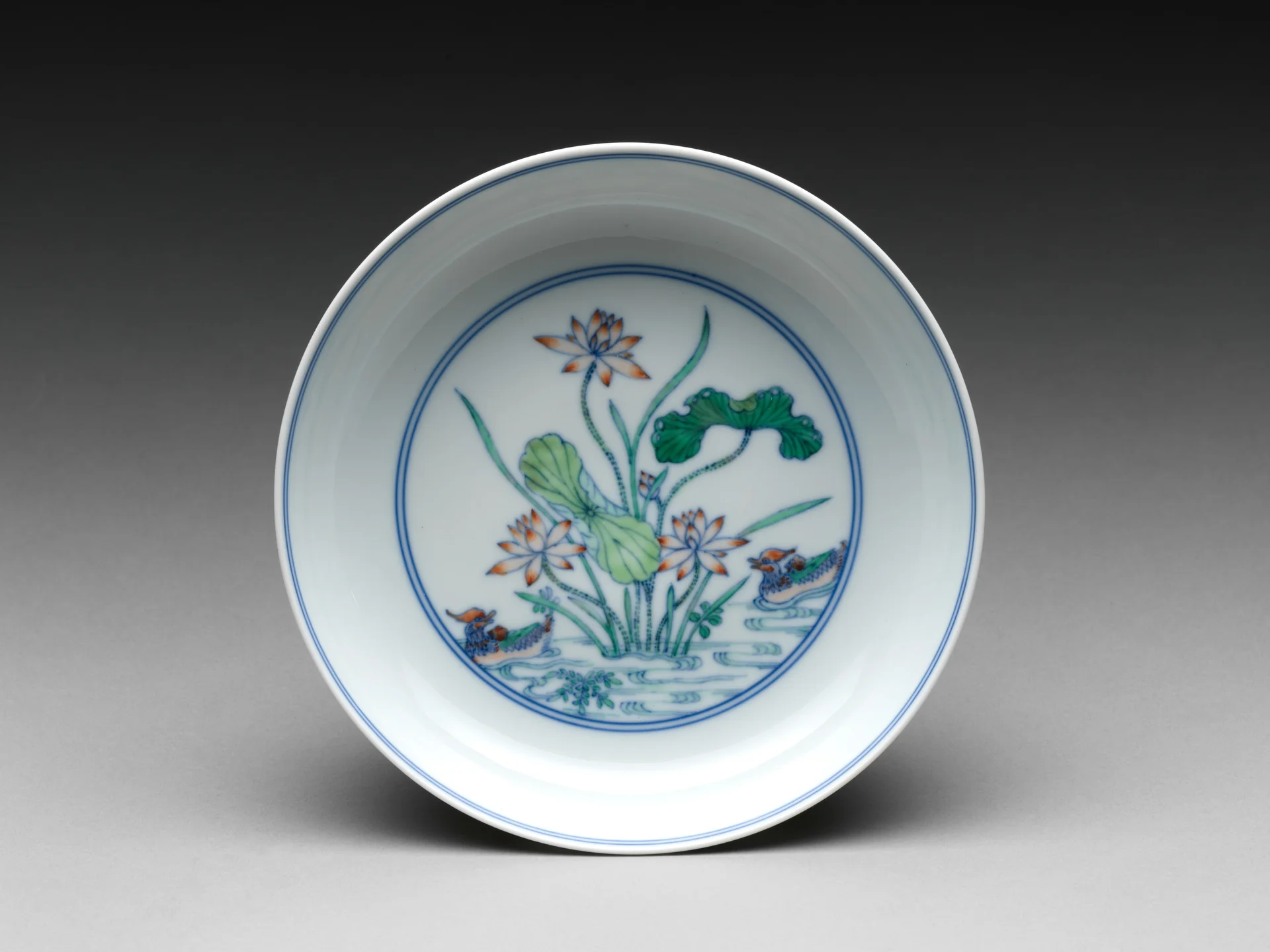
The Met identifies its Dish with Lotus Pond as early eighteenth-century Jingdezhen porcelain, with a Yongzheng mark and period, 1723–35. The decoration combines cobalt blue beneath the glaze with colored enamels above it.
Green leaves rise among lotus flowers, with water birds beside the stems and blue lines running through the water below. The white space around the pond leaves the drawing easy to follow. The separate colors make a compact scene without covering the whole interior of the dish.
The technique is known as doucai (斗彩), or joined colors. The Met’s explanation places the blue outlines under the glaze and the colored enamels over it. Following one leaf from its blue edge into its green center makes the division of work easier to imagine: one finished motif belongs to two painting stages.
The blue drawing comes first, followed by glazing and high firing; the added enamels then receive a lower-temperature firing. The British Museum describes that sequence in its account of doucai.
I find the leaf more revealing than a label applied to the whole dish, because the small detail holds both processes together.
06 / The guide
Overglaze painting carries a story as well as color
The lotus pond uses color to build a natural scene; the Pan An platter uses it to stage a crowded human one. Its court includes buildings, spectators, and a small cart drawn by a goat. The view spreads across the broad dish, with figures occupying several parts of the architecture.
The Met reads the central story as most likely showing the writer Pan An being showered with fruit. It also points out that the goat-drawn cart belongs to the story of another handsome young man, Wei Jie. The painter combined elements from the two tales in one scene.
The cart carries a clue. At first it’s a lively detail near the bottom of the picture; with the museum’s explanation, it becomes evidence of a painter bringing stories together. The institution isn’t certain about the main identification. I’d keep that uncertainty with the object.
Overglaze painting offered a surface on which a decorator could arrange these colored figures, buildings, and borders. The result asks for attention at two scales: the whole courtyard, then the small action or costume inside it. The same colored surface can reward a quick glance and a much slower reading.
07 / The guide
Reading overglaze porcelain beyond its brightest colors
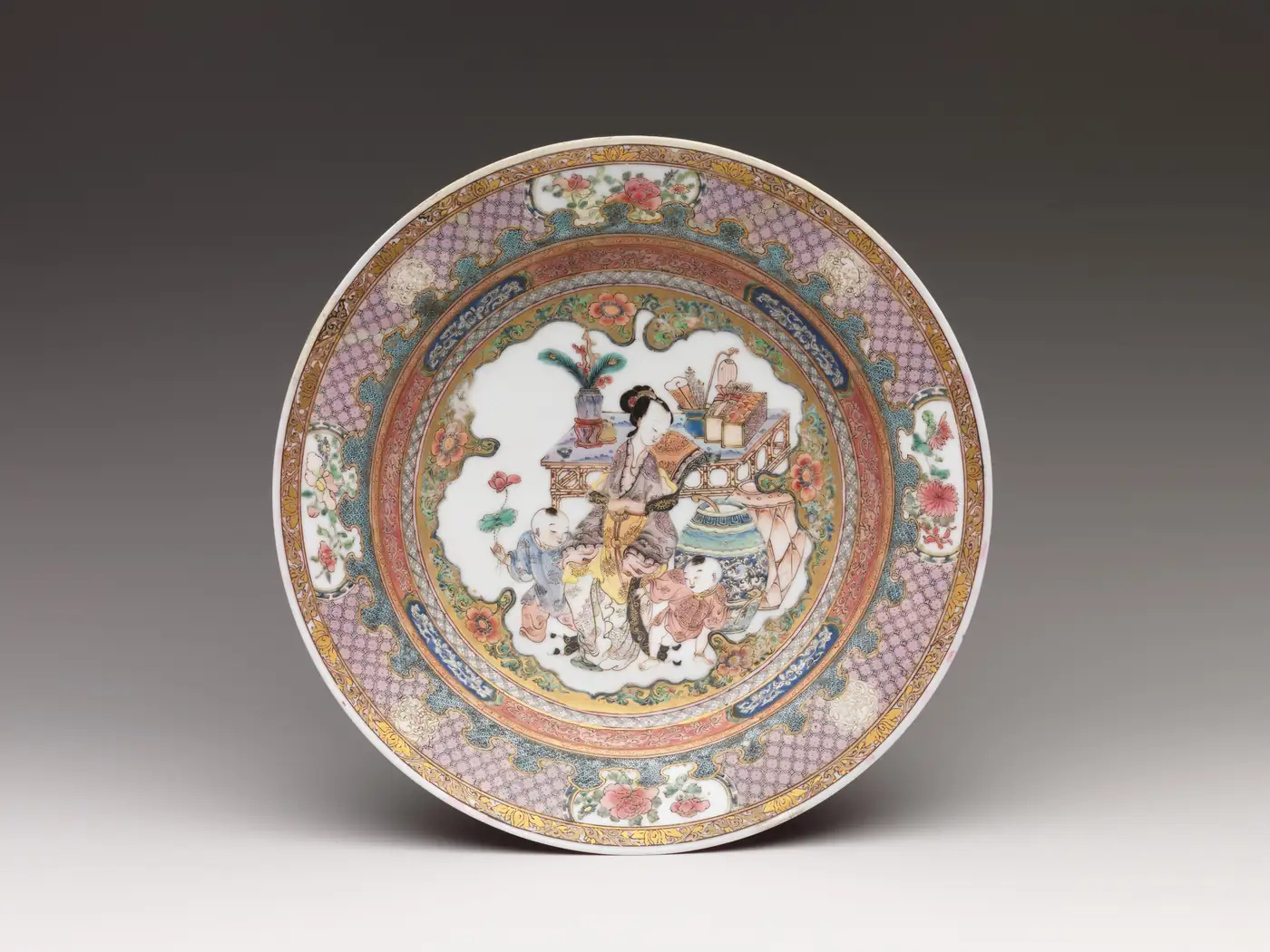
A smaller dish brings that slow reading back to pink. The Met’s Dish with Scene of a Woman and Children dates to the middle of the eighteenth century and is cataloged as Jingdezhen porcelain painted with overglaze polychrome enamels and gold. Pink appears in the children’s clothing and in a patterned border.
The woman and children occupy a white central field, while densely patterned bands surround them. Flower panels interrupt the pink ground near the rim. Moving from the center outward, I notice how each change of border gives the eye a brief pause before the next band begins.
A photograph shows those relationships between colors and shapes; the catalog supplies the material and historical identification.
For a contemporary piece, the maker’s instructions and documentation are the place to check intended use and care. The word “overglaze” alone gives a decorative position, not a test result for a particular plate.
What stays with me on the woman-and-children dish is the movement between a tiny pink sleeve and the broad pink border. Both belong to the painted surface, but they do different work in the picture. Once the glaze and the later enamels have separate roles, that small choice of color becomes much easier to see.
Published · Updated